
Tag: USA – Montana
Mime School
Bound – Unbound
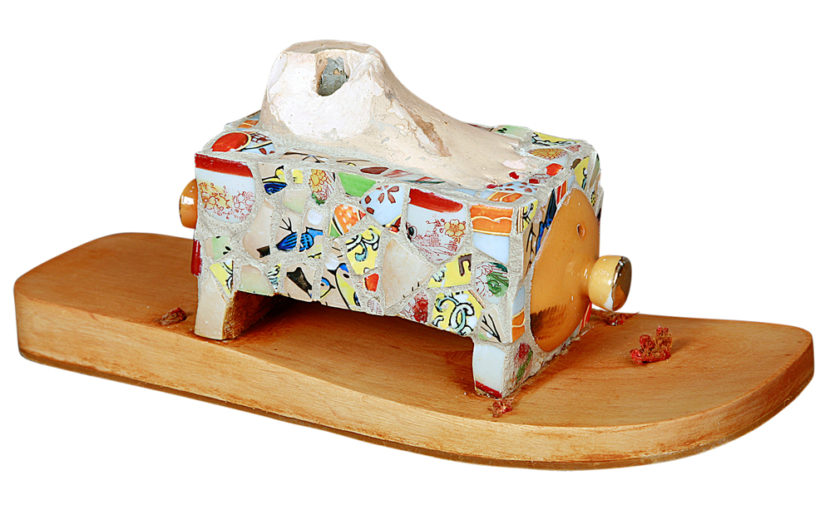
“The child’s foot doesn’t know yet that it’s a foot,
And wants to be a butterfly or an apple.
But then stones and pieces of glass,
Streets, ladders
And the paths of the hard earth
Go on teaching the foot that it can’t fly,
That it can’t be a round fruit on a branch.
The child’s foot then was overcome, it fell
In the battle,
was a prisoner,
condemned to live in a shoe.”
From To the Foot from Its Child
By Pablo Neruda
Sharing
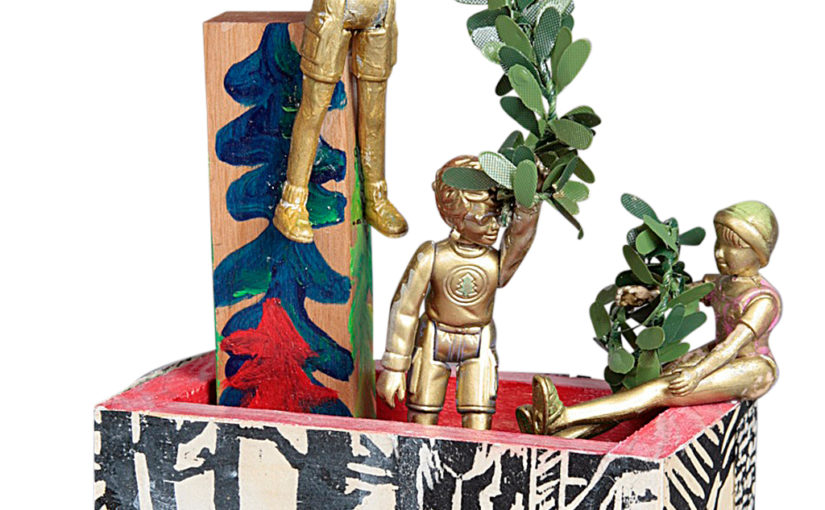
I Can See Beyond…
I Can See Beyond the Forest and Thru the Trees Now speaks for all modern women and will hopefully in the future. We no longer are tied to aprons, but represent a significant change in our roles, as mothers, policy makers and breadwinners. In the 60’s, we were underpaid as educators and had less chance to be put into responsible position in life than our counterparts. We have come a long way in forming the framework for the future.
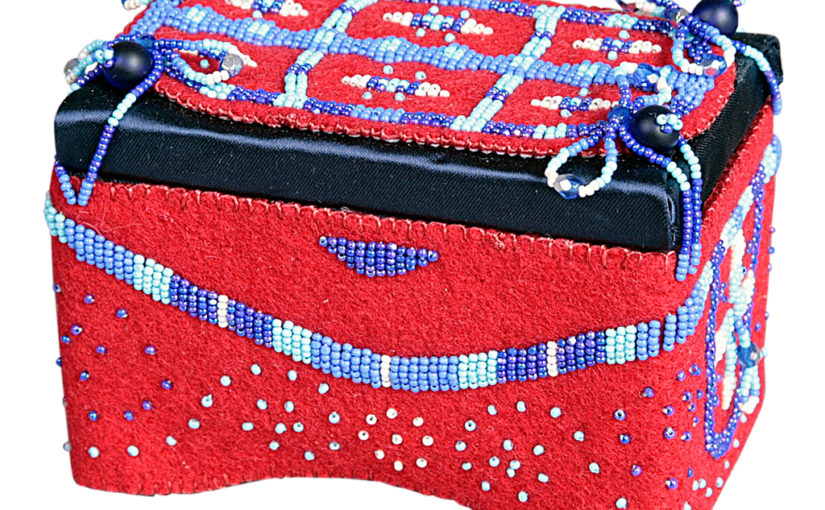
Turtle Island Umbilical Fetish
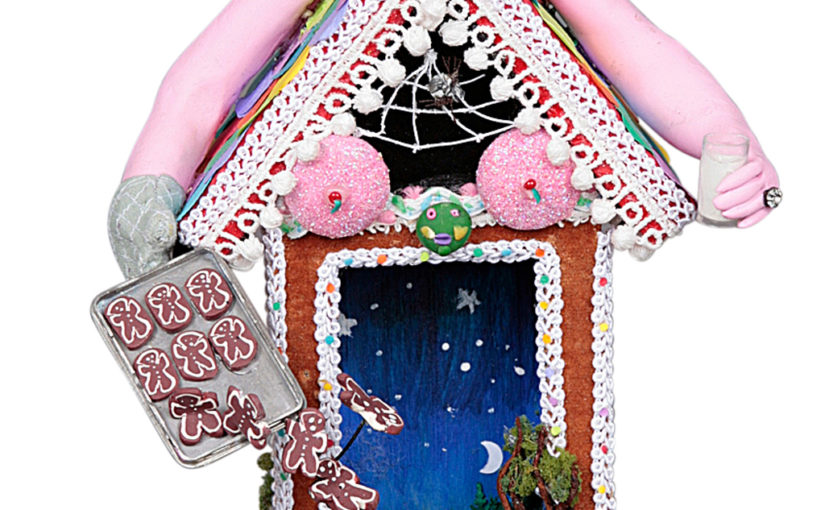
Domestic Goddess
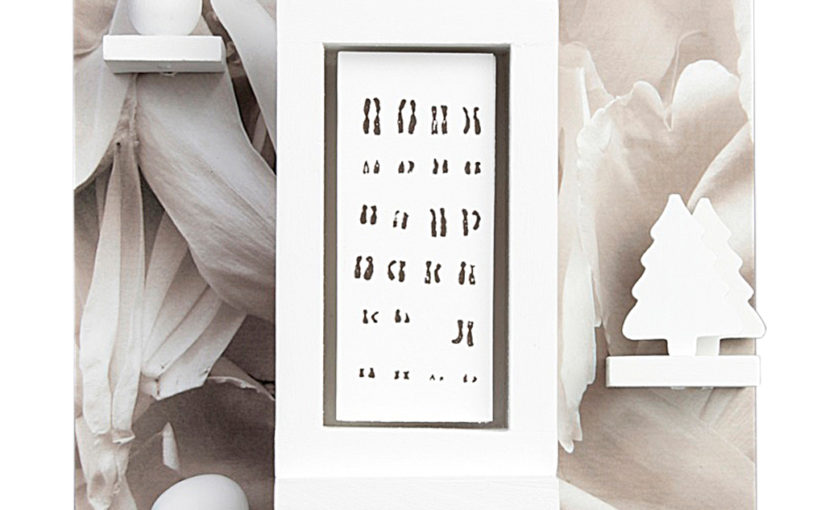
Altar for Eve’s Chromosomes
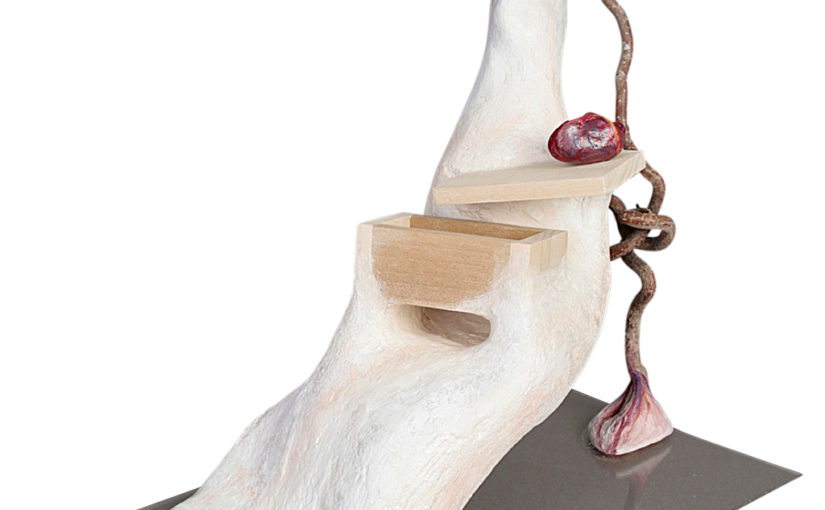
Eve represents the first woman. I am honoring her genetic material with this mixed media sculpture. All women have descended from Eve’s chromosomes, which are the most fundamental, significant and potentially eternal part of our experience as humans.
Artistically, this work is related to a series of white wood wall sculptures I made during the late 1980’s. The objects I have added to the original box materials are symbolically related to women’s genetic and cultural heritage.
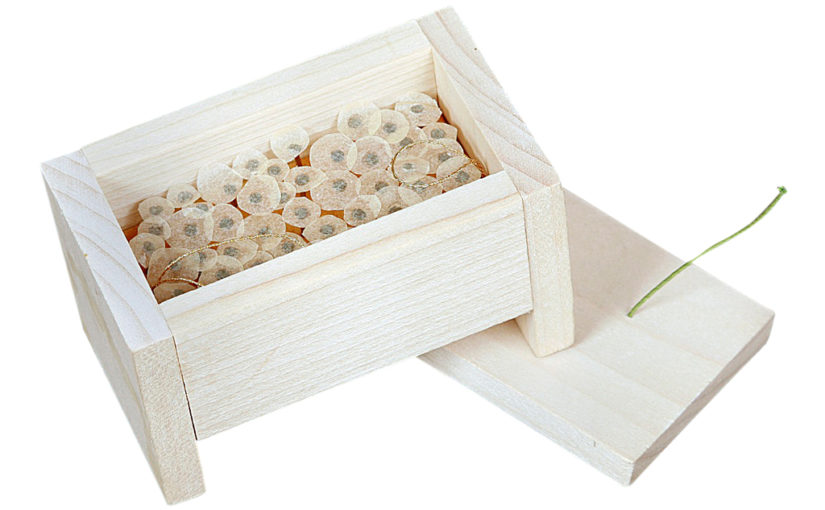
Personal Dandelion Patch
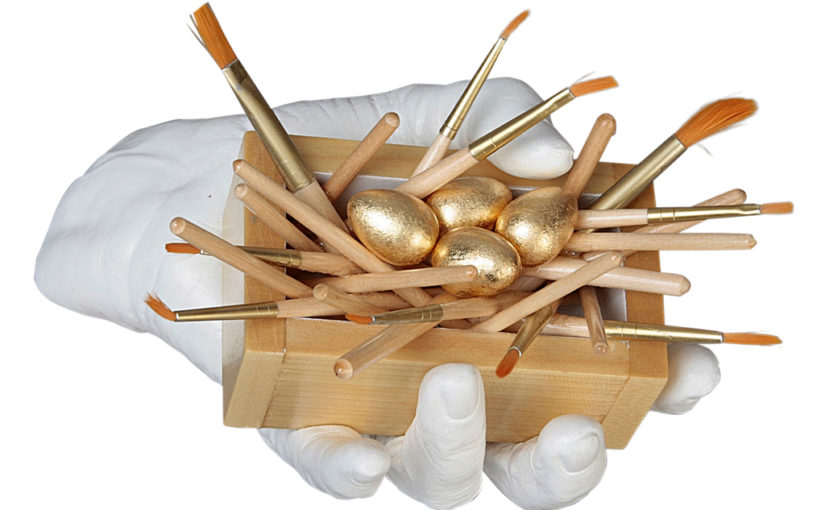
Nurture
We take care of things that are important to us. The females of most species are considered to be nurturers and keepers of the “nest”.
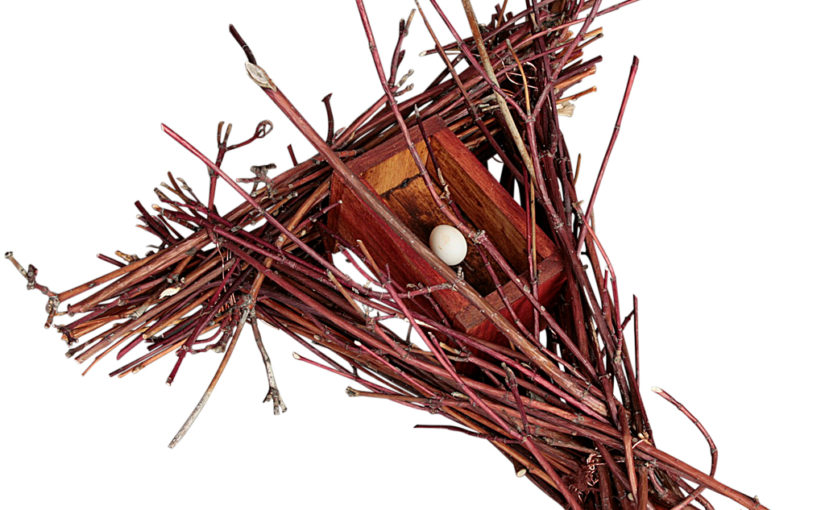
Being and artist has allowed me the opportunity to nurture the things that are most important to me – represented by the golden eggs in the nest of brushes. I care about many things and to limit myself to representing just four became a daunting task – I thought about Peace, Love, Compassion and Creativity, but upon reflection each day, the list grew. How could I not mention family, good health, rich soil and clean water, friendships and the miracle of simply being whole?
So without putting words to the golden eggs, I’ll leave it for those who view the art to ponder…How and what will you “nurture” in your life? We must take care of what is most precious to us.
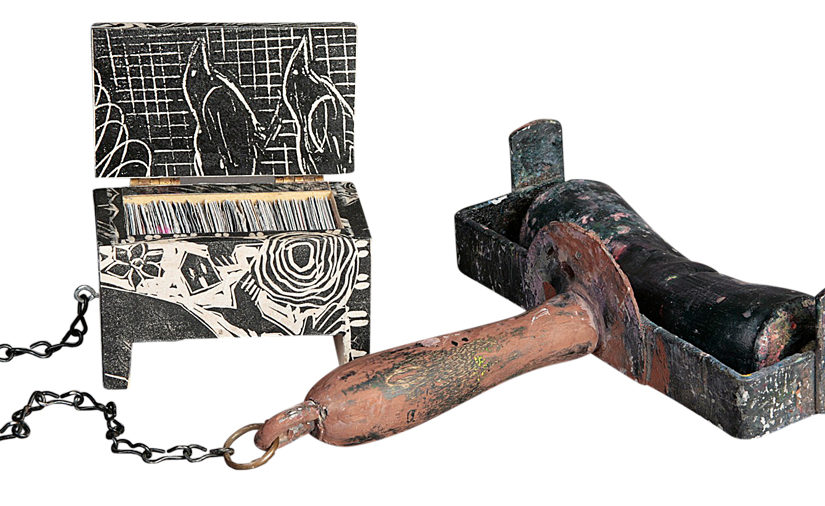
Remnants
Remnants references my many, may years as a working artist, particularly as a printmaker. I selected remnants from 30 years of art-making into the contained box, making my own sort of small “retrospective”. Working on this piece brought up a wide spectrum of memories, thoughts and emotions – and the toil and labor that go into a work of art. I consider myself a very fortunate person.
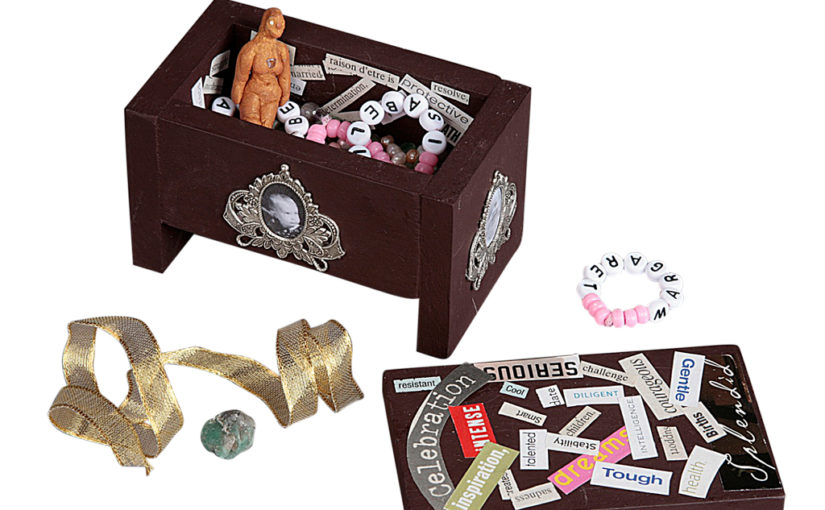
Granfaloon of 3
I adored my maternal grandmother and gave my daughter her name. Isabella. One day when my daughter was a tiny girl, she said to me, out of the blue, “Remember when I was the big lady and you were the little girl? Wasn’t that fun?” It was fun.
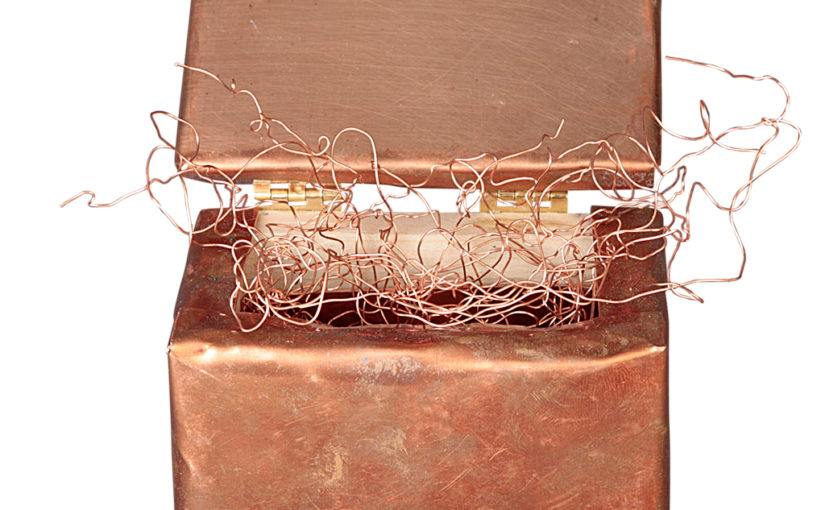
An Empty Nest, An Open Coffin (for Quintan)
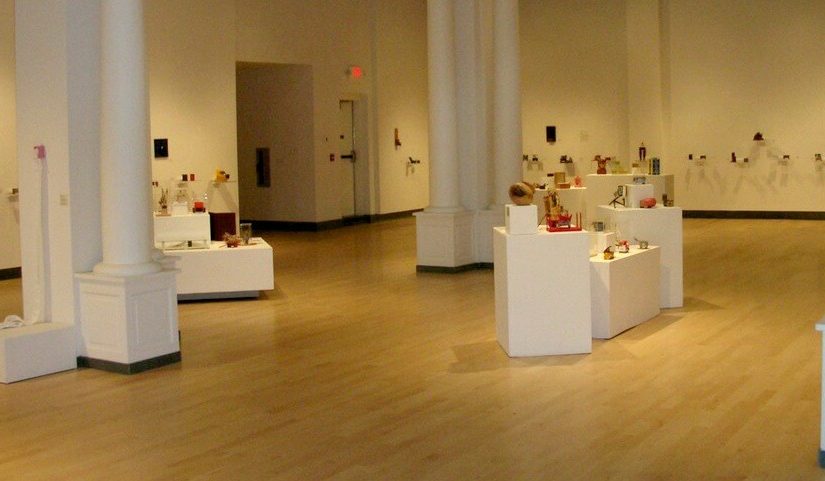
MONTANA

Missoula Art Museum
Missoula, Montana
March 12 – June 8, 2007
Laura Millin, Executive Director
Steve Glueckert, Curator
Renee Taaffe, Curator of Education
Meridith Rippey, Missoula Art Museum Visitor Services
Cricket Winfield, Coordinator
Missoula Montana continues to feel the ripple effect of Women Beyond Borders.
– Cricket Wingfield, WBB Coordinator

Over 1,200 fifth graders from Missoula County came to the museum every school day for three months throughout the exhibition to view the boxes and to discuss women’s issues. As the students entered the museum, both boys and girls were given cards with a specific issue relating to women. They viewed the works and collected information in reference to their card. Earnest discussions followed giving the students new insights into women. Next, the group viewed the WBB World Tour video and then created their own boxes.


Thinking INSIDE the box:
Local artists add their voices to world-touring ‘Women Beyond Borders’ exhibit
April 26, 2007
By JOE NICKELL of the Missoulian
The exhibit includes work by women survivors of genocide in Rwanda. The box on the right, titled “Beatrice’s Box – A Coffin” by Beatrice Nicyascra, shows figures representing her four children and a drawing of her husband who was hacked to death while she was forced to witness.
Think you know what a box is? Google offers 44 definitions of the word, drawn from 32 different sources. Yes, a box is “a (usually rectangular) container,” but it is also a “compilation of rare and unreleased tracks by Klinik,” and a “juggling pattern for three objects, most commonly balls or bean bags.” It is a technique of cocktail mixology, a hockey strategy, an area of a craps table, and slang for a tornado watch.
Not one of the definitions dredged up by Google mentions the word “feminine” or “woman.” Yet to more than 900 women in 50 nations around the world, a simple, pine box has become a symbol not only of femininity, but of the cultural concerns, economic challenges and personal struggles that bind all women around the world.
Expressions of that symbolism are currently on display at the Missoula Art Museum as part of an exhibit, titled “Women Beyond Borders.” The traveling exhibit, which has circled the globe over the past 16 years, is the brainchild of Santa Barbara, Calif.-based artist Lorraine Serena, who visited Missoula recently for the show’s local opening.
“The box is a shrine, it’s a vessel, it’s a womb, it’s a tomb,” said Serena in an interview with the Missoulian. “There are so many ideas and concepts familiar to women that attach to the box, even though it’s a rigid object. It has been life-altering and mind-boggling to witness the range of concepts and expressions that women have come up with in response to this simple little box.”
The project traces back to 1991, when Serena and a group of other Santa Barbara artists were trying to dream up an art experiment that could involve women from around the world, something that would address issues of politics, identity and community. They lit upon the idea of the boxes for reasons both practical and metaphorical.
“We were trying to think of something that would be easy to ship around the world, and that would have a lot of symbolism and opportunity for artists to interact with in a meaningful way,” said Serena. “I put some of the found objects from my artwork on a table, which included a small box. We looked down and thought, that’s it, the box.”
The organizers – led by Serena and Elena Siff – launched “Women Beyond Borders” by sending out 200 pine boxes, each measuring just 3 1/2 inches by 2 inches by 2 inches to artists around the world. Initially, they contacted artists with whom they had some degree of connection. But as word of the project spread, requests and contributions came in from unexpected quarters around the globe.
“It spread so fast even with an assistant we could hardly keep up,” said Serena. “It seemed like every day we were getting them submitted, from just everywhere. It was such an unexpected experience of life – I feel it was almost a part of a destiny for me.”
The first exhibit, featuring 185 artistically altered boxes, took place at the Santa Barbara Contemporary Arts Forum in 1995. Since then, the exhibit has visited 47 locations in 50 different countries. If that math seems backwards, it’s because one of the exhibitions literally traveled, on a train, across eastern Europe.
“This group of women had the idea to hold the exhibition on a train going from Austria to Russia,” explained Serena. “They exhibited it in the berths for people as they traveled. The show went across recently opened borders, carrying the boxes, so they really made the idea interesting.”
The exhibit was part of the 2002 Cultural Olympiad, in coordination with the Winter Olympics in Salt Lake City. It has also visited a shopping mall in Canada, a temple in Katmandu, airports and the Ontario International Airport near Los Angeles.
“We go where the boxes are wanted,” said Serena. “This is not the kind of thing that is meant to be only for museumgoers.”
It is also not meant only for practitioners of fine art. Many of the contributors to “Women Beyond Borders” are first-time artists; others are professional craftspeople.
“The boxes have come from women who live in very humble places to very elegant places, women who have a lot of creative experience and women who have very little or none at all,” said Serena. “Our goal has always been to honor and document the whole range of women’s voices around the world.”
Kelly Garrett strolls past some of the boxes made by artists from 50 nations at the Missoula Art Museum Tuesday afternoon. The exhibit, “Women Beyond Borders,” has circled the globe over the past 16 years, includes 900 boxes and has recently has grown to feature work from Missoula artists.
SEE MONTANA BOXES