
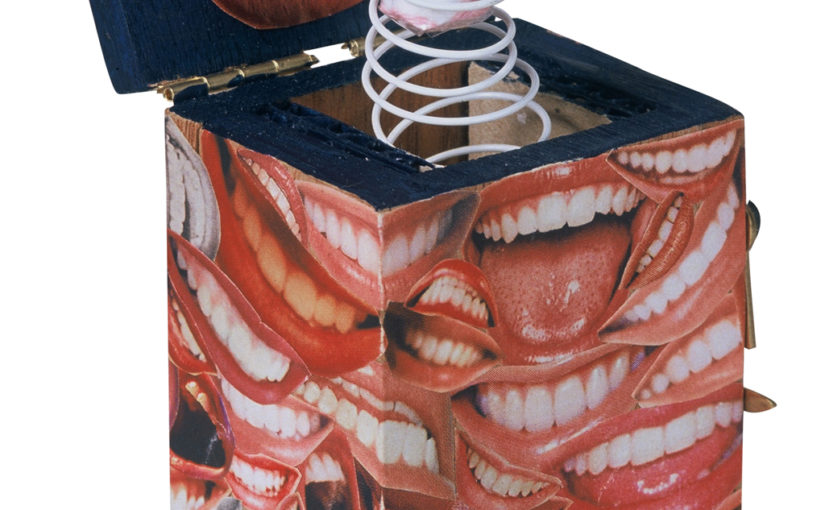
GRRRLS Teen Box Project.
Tag: Australia
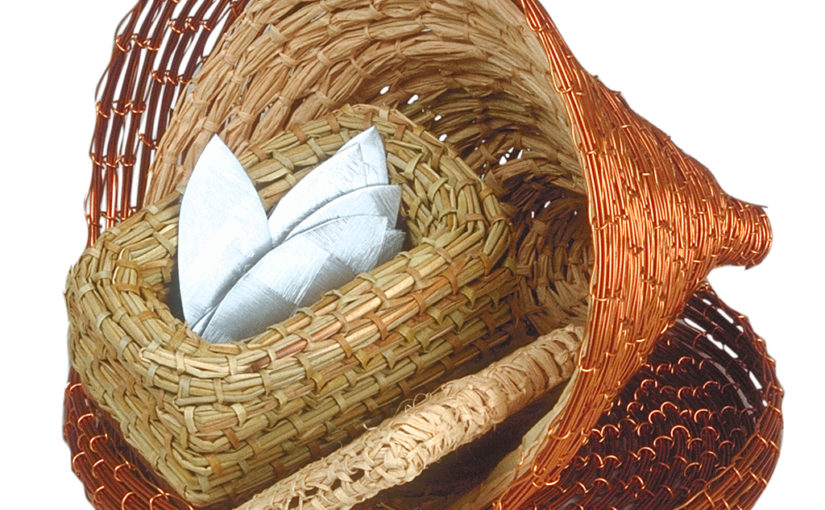
What the Women Gave Me
The making of this second box afforded me the opportunity to reflect on and celebrate the many wonderful and precious things given to me by women; artists friends colleagues, and strangers whom I will never meet, who share like souls…
To the Ngarrindjeri* Woman who taught me how to weave, and gave me a part of her culture…
To the Women who nurtured and encouraged my talents and refused to let me give up…
To the communities of Women who have taken part in Women Beyond Borders…
Thank you.
* Ngarrindjeri (pronounced narr-ind-jerri), people are indigenous Australians, originally from South Australia. These people traditionally wove to make traps and baskets in which to gather, store and carry their food and bury their dead. Today few Ngarrindjeri know how to weave.
The Women's Voices: Diana Robson from WOMEN BEYOND BORDERS on Vimeo.
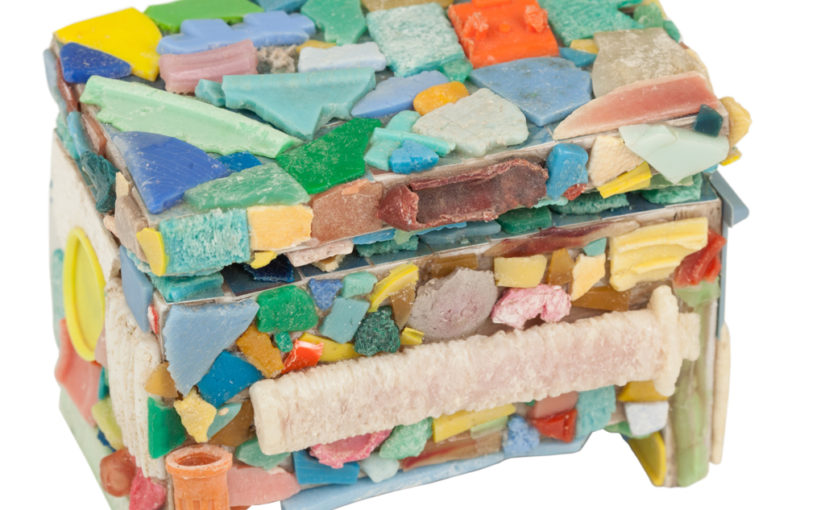
Souvenir From Hawaii
I have covered the surface of this box with pieces of plastic found on a beach in Hawaii in 1993.
On one hand, I saw all this plastic as evidence of the persistence of this detritus of capitalism’s endless appetite for more THINGS; on the other, I was struck by the weathering of these ambiguous fragments as they begin to resemble organic flotsam and jetsam.
The categorizing of things washed up like this becomes more difficult and the beach becomes a shifting archeological site of displaced artifacts (or garbage) driven by the tides. Presumably, eventually these things break down into a kind of synthetic sand.
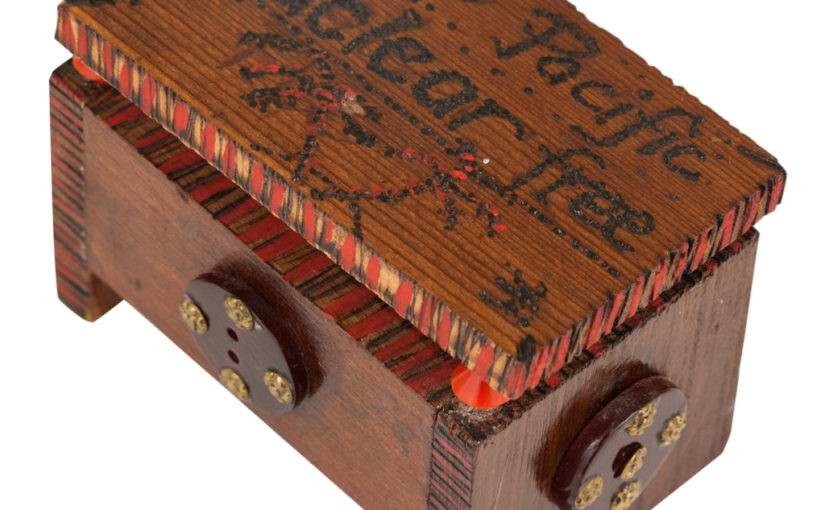
Keep Pacific Nuclear Free
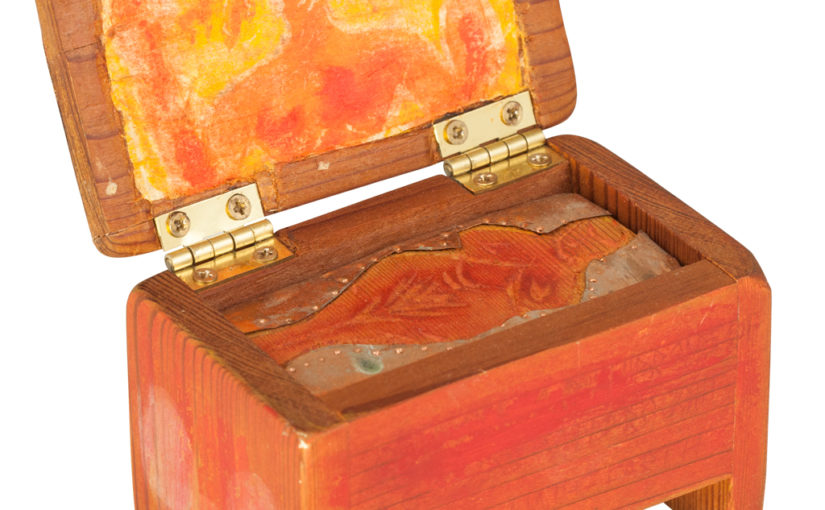
Pandora’s Box
The subject of this work, Pandora, like Eve, Lillith, Medusa, had her meaning and function inverted during the establishment of the patriarchal gods. Originally a persona of the earth goddess who rose from the earth with outstretched arms bringing life sustaining gifts of fruit and plants, she was rewritten, and like Eve became the source of misery and punishment for the human race.
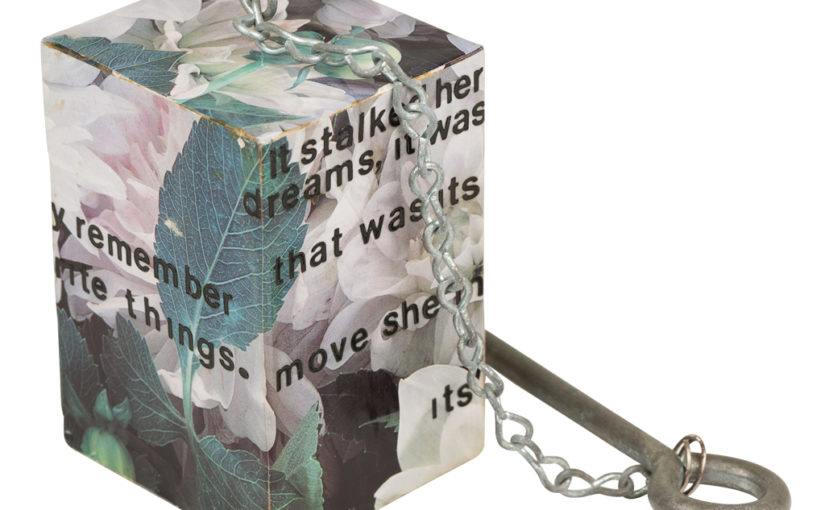
My Favourite Things
My most recent work has been installation-based amalgamations of photographic images and text, the result of which is a cross-over into an almost cinematic form and aesthetic. My practice has shifted from an analytical approach to the concepts outlined above to a more personal exploration of them. My use of image and text alters the codes which are usually brought to bear in ‘readings’ of these mediums. Each form is pushed aside in favor of the other, forcing them to jostle each other for primacy. The text is always my own writing, which consists of nightmarish vignettes (real and imagined), frequently including references to some popular cultural homily, in order to insert some humor/irony, and to suggest that there are certain pleasures to be obtained from the so-called negative aspects of culture/existence.
I decided to base my box on work I am currently exhibiting in a group show titled Fear Incorporated. I have closed and enclosed my box to suggest the mystery of that which is hidden (psychological/cultural, whatever). I then re- inscribed the surface of the box (or the cube it has become) in two layers. The first layer – photographic flowers, dissimulating nature – seduces, as only images of natural beauty can, yet forms a surface which shuts off investigation. The next layer – the text touches on the mysteries of the subconscious. The box spins around on its chain to laugh at the simplification of these complexities inherent in such ideas produced within popular culture (albeit a somewhat nostalgic, dated form of it) as “I simply remember my favorite things.” At the same time it suggests the potential for a kind of pleasure to be found in that which is relegated to the negative.
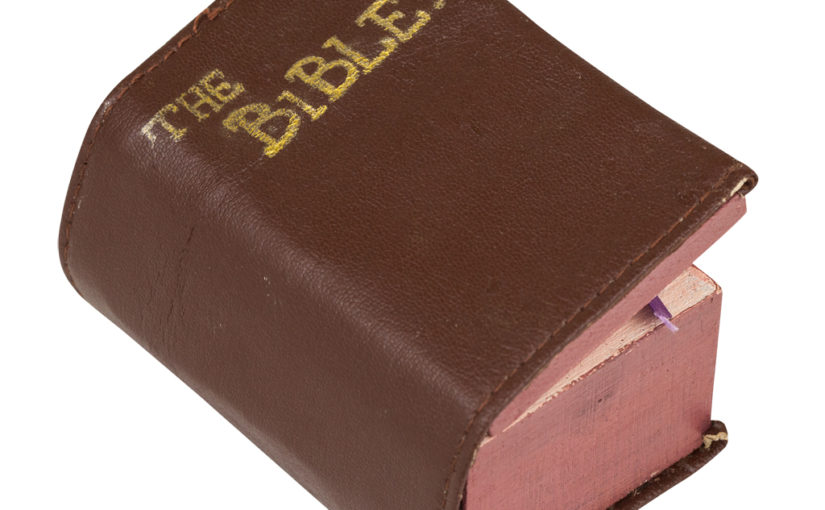
The Bible
Then the Lord God made the man fall into a deep sleep and while he was sleeping he took out one of the man’s ribs and closed up the flesh. He formed a woman out of the rib and brought her to him. Then the man said, “At last here is one of my own kind.”
Genesis v, 22-23
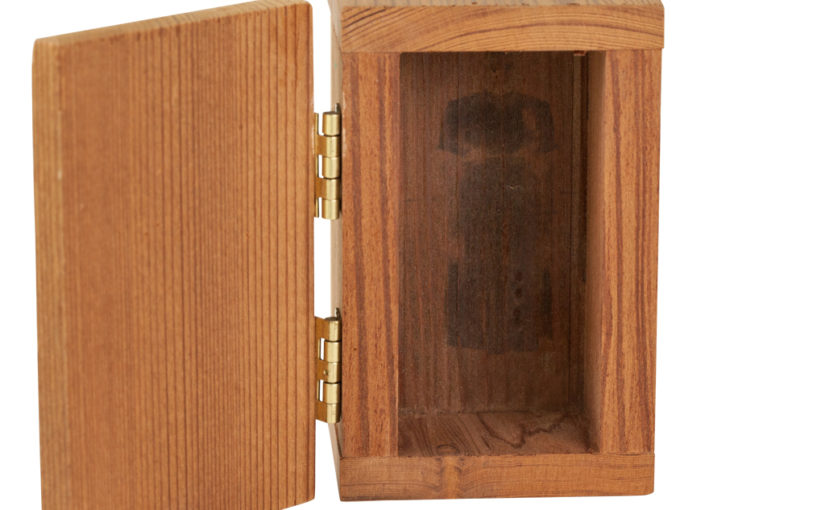
Untitled
If I could place history on a light box
and make its face transparent
I could illuminate its unseen structure
upon which its strength depends.
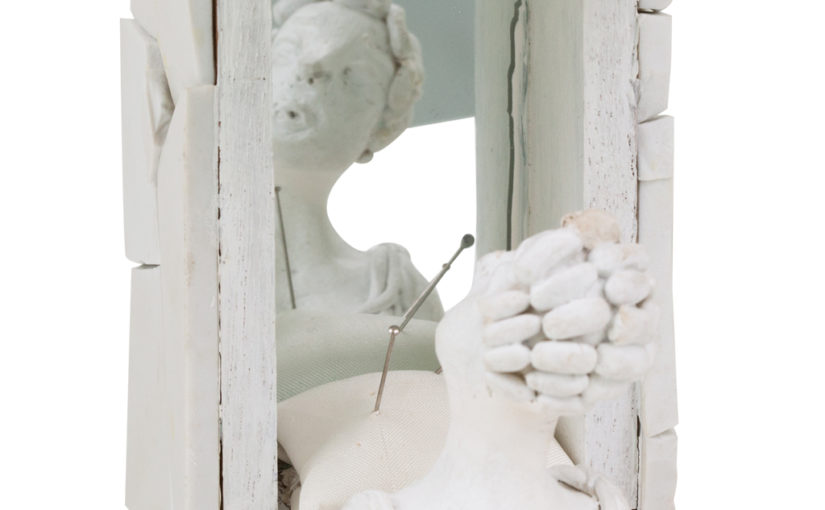
Untitled
GRRRLS Teen Box Project.
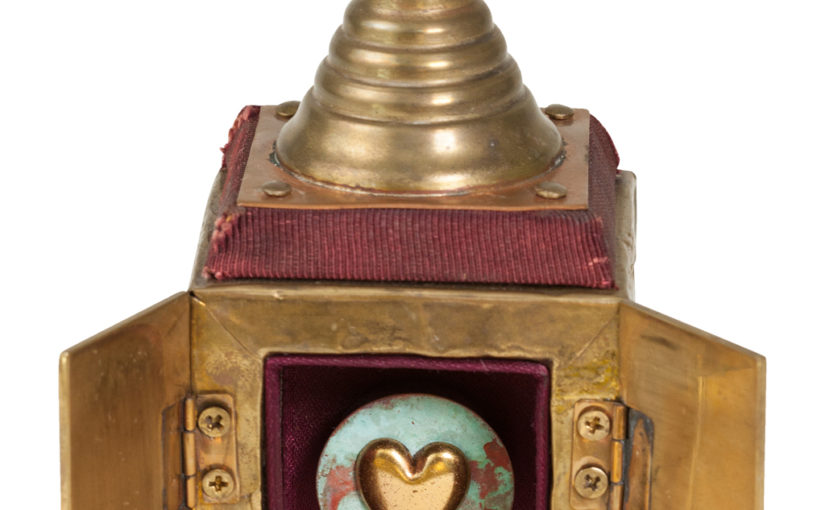
May You Continue To Inspire
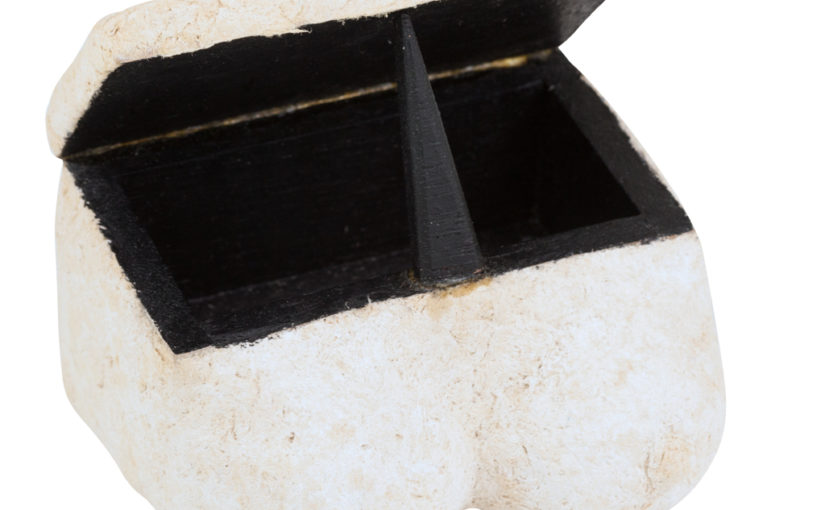
Untitled
GRRRLS Teen Box Project.
If it weren’t for her skull, the head would cave in on itself.
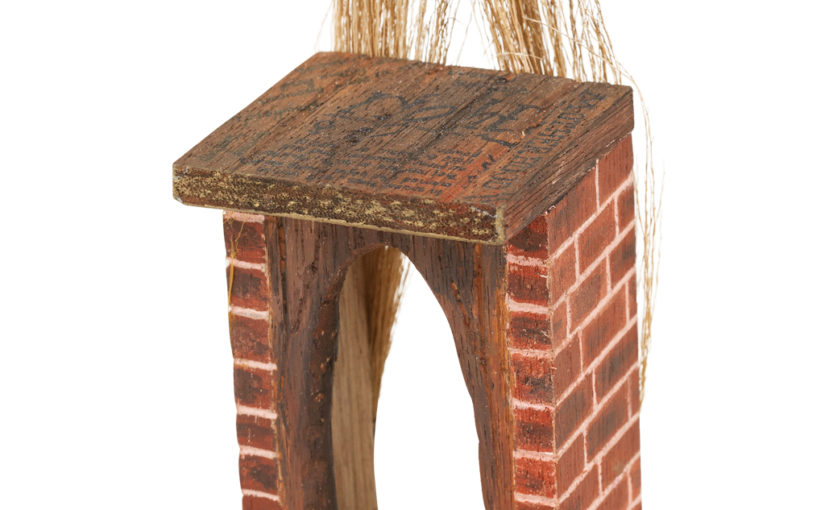
Welcome
GRRRLS Australia Teens project.
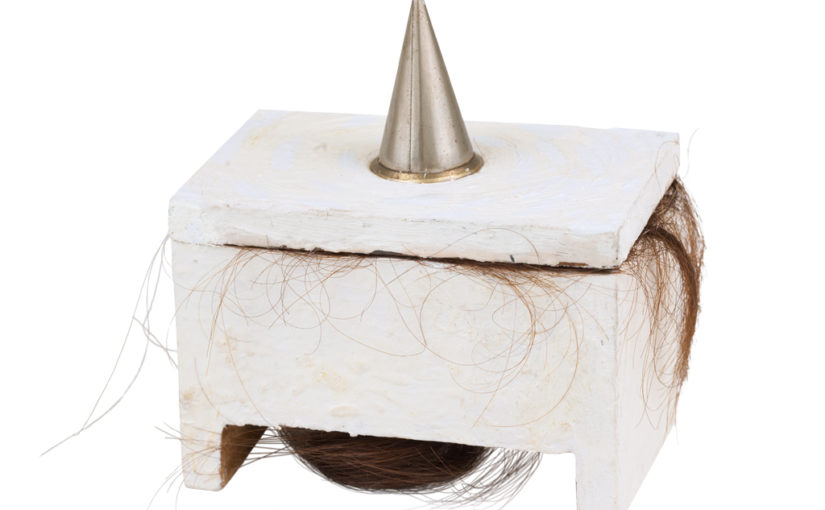
Keeping the Lid On
I am interested in the matters of the psyche and how that is reflected in everyday life, as well as myth, symbol and stories. This work Keeping the Lid On could also be called a bee in her bonnet or stirring up a hornet’s nest.
Jan Fieldsend from WOMEN BEYOND BORDERS on Vimeo.
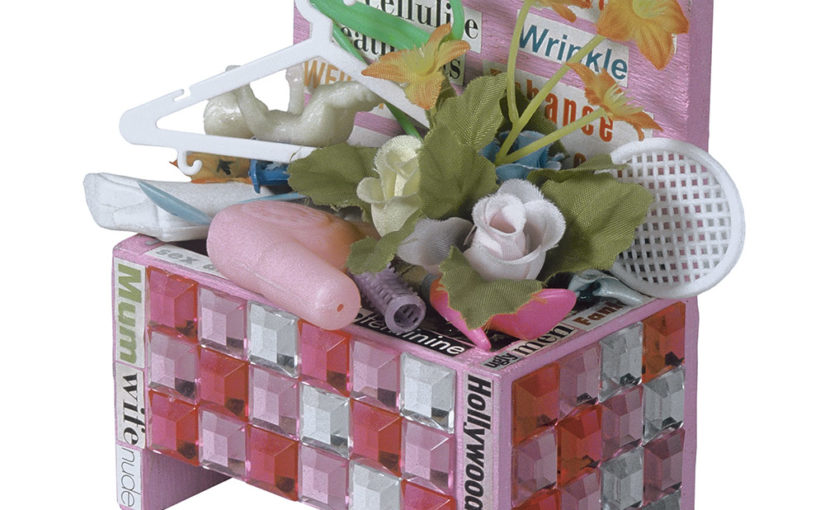
The Price Of Beauty
My piece is a treasure box that is beautiful and appealing on the outside, but on the inside it contains the bad things about being a woman, i.e. dieting, sex, wrinkles, which in turn is the price of beauty.
AUSTRALIA
TIN SHEDS GALLERY, UNIVERSITY OF SYDNEY
August 27 – September 19, 1999
Sydney, Australia
Jan Fieldsend, Director and Curator
Nazanin Marashian, Wbb PROJECT Coordinator
MANLY ART GALLERY & MUSEUM
September 22 – October 17, 1999
Manly, Australia
Therese Kenyon, Director and Curator
Samantha Tunbridge, Assistant
BROKEN HILL ART GALLERY
September 30 – October 17, 1999
Broken Hill, Australia
Diana Robson, Director and Curator
IN THE OUTBACK
In a town as isolated as Broken Hill, the idea of ‘community’ takes on added meaning. With the isolation comes a feeling of ‘us’ and ‘them,’ there are those who are from here, everyone else is ‘from away.’
Is it possible to feel a sense of community with a group of women, most of whom I will never speak to, nor even meet?
It is four years since about two hundred other women and myself were each given a small wooden box and instructions to transform the box in any way we so desired. I have never been to Finland, Cuba or Japan. I do not know what these people look like, I know nothing of their history, however in the creation of their boxes something personal has been revealed, something intimate has been shared.
To others this may seem a very tenuous connection on which to base a sense of community, however to me it is powerfully real.
– Diana Robson
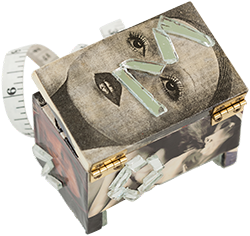
Ironically, rather than dealing with ‘the individual’, Western society tends to place us in particular categories (little boxes) and more specifically opposing polarities in order to deal with us more easily, more quickly, less personally. This easy stereotyping is even more prevalent in regard to the position of women: Madonna/Whore, Mother/Worker, Young/Old, Beautiful/Ugly, Nature/Culture. This box contains references to the stereotyping that we as women experience and the title, We are This and That and Everything in Between, refers to the true individual nature of the female sex.
– Diana Robson
Diana Robson, Director of the Broken Hill Art Gallery
Therese Kenyon, Director of the Manly Art Gallery
Jan Fieldsend, Director of the Tin Sheds Gallery
Student Boxes from Stella Maris College in Manly, Australia
STUDENTS BEYOND BORDERS: ADJUNCT PROJECT
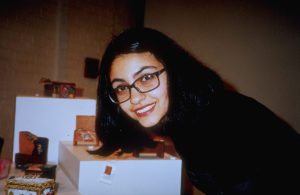
Nazanin Marashian from the University of Sydney invited a group of university women to participate in the WBB exhibition and assist in the preparations of the WBB exhibition at the Tin Sheds Gallery, University of Sydney in 1999.
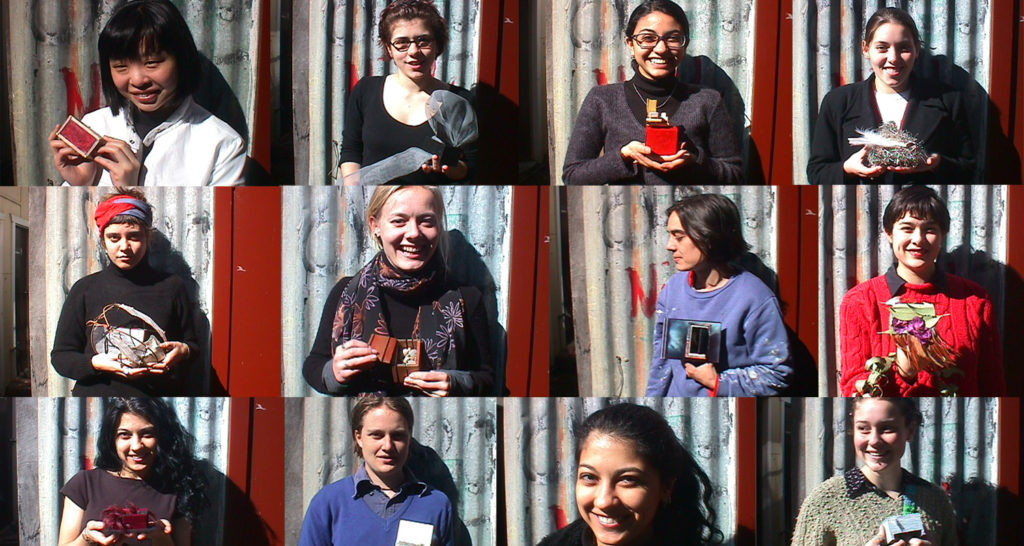
As part of the expansive opportunities that WBB ignites, the 12 University of Sydney artists have joined to form the Wbb PROJECT. The Wbb PROJECT is an exciting supplement to the Australian tour of Women Beyond Borders, with the generous support of the Tin Sheds Gallery, the University of Sydney Union Cultural Grant Scheme and FASOC, they have been able to develop a working relationship with WBB and become part of an international women’s art event. The aims of the Wbb PROJECT are to recreate the sense of community and dialogue that WBB has illuminated since its first exhibition, this time on a local level.
The Wbb PROJECT is structured as a mini-curatorial endeavor, an exhibition within an exhibition, running for approximately six weeks. An artist’s space at the Tin Sheds studios was established with weekly meetings of creative production and dialogue.
During its run, the Wbb PROJECT produced an art catalog, a series of t-shirts, and a website, all in service of expanding the voices of women in their community. The ambitions, talents, and support of everyone involved have been a true inspiration, giving all who come in contact with this extraordinary exhibition the motivation to keep extending the borders until they finally disappear.
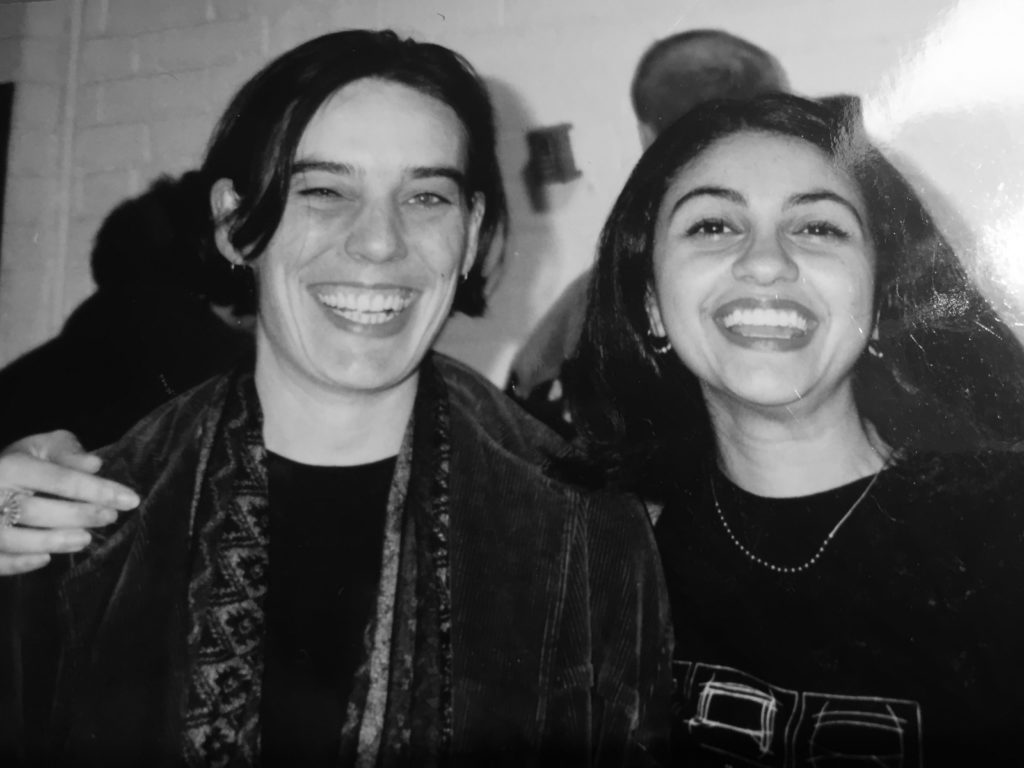
GESTURING A PLACE
Nazanin Marashian, Student, University of Sydney – AUSTRALIA
On my 7th birthday my mother gave me a box. A magical, mystical box. The kind that captures a child’s imagination. Inside, was a ballerina wearing a red tutu. She danced to an indiscriminate song and as she twirled, dreams, blanketing consciousness, soothed the child to sleep.
I filled the box over the years with my most precious possessions. A blue and white beaded necklace, sent from Iran by my Grandmother. A pebble, which, once held in my hand made me invincible. My first watch. A gold ring. A rose. It became for me a private house– a secret site of childhood fantasy and pleasure. Since then I’ve collected numerous other “boxes”: a tool box, a letter box, an artist’s box….all carrying something of the past and the present. Containers of memories which fuse together to define who I am, or who I attempt to be.
Twelve years later, on my sister’s 7th birthday I gave her my magic box, enchanted with secret dreams of yesteryear, to share with her not only my object fetish but also, to inspire her own imagination. The box became a sacred rite, a passage of symbolic connection between two sisters– two women.
We all create or are given “boxes”, real or metaphorical. These boxes are endowed with an alluring mystery– a whispered game of desires, ambitions, fears. Yet, they are at the same time, an ambivalent object which define boundaries. A closed space, a private space, a space which can expand your mind, or suffocate your soul.
Investigating the “boundary” is at the heart of Women Beyond Borders.
The box can be understood in all languages and points of reference. It is a thing which stands as a representative of a common link– that we as women, as living beings need to speak of the whole of our experience: the hostility, the sadness as well as the joys and triumphs.
The WBB exhibition brings that reality to fruition both in its boxes and through its travels.
The opportunities this exhibition has offered throughout its five year existence, whilst acting as an agent for the ideas and feelings of women, has encouraged and inspired creativity and above all communication. Communication both cross-culturally and trans-globally. In Russia the boxes traveled on a train from Graz to St. Petersburg, a moving sculpture, which literally crossed eight borders. The event was filmed and aired live via the Internet at the Austrian and American WBB exhibition venues. In Kenya, WBB acted as catalyst for further women’s art exhibitions. In Nepal a doctor carried the boxes into remote villages where they were shown to local women, as a means of raising awareness of health issues. There have been numerous workshops, and supplementary web sites, designed to showcase artists who utilize digital media and to promote education in digital arts for women.
Change develops out of knowledge. Making visible the spectrum of experiences, both on a personal and global scale is the power and appeal of WBB. Whatever the individual boxes speak of, whether it be personal stories, political issues, or formal concepts, it is in the space of the exhibition that the communication and debate comes alive; and via this spark moves beyond the walls and into the world. Private spaces made public.
Like my magical, mystical box, the Women Beyond Borders project gestures a place for the imagination. As a meeting of strangers and friends across seas, cultures, and languages, the exhibition becomes a universal sign of community; the passing on of ourselves through the gift of a box.
SEE BOXES FROM AUSTRALIA
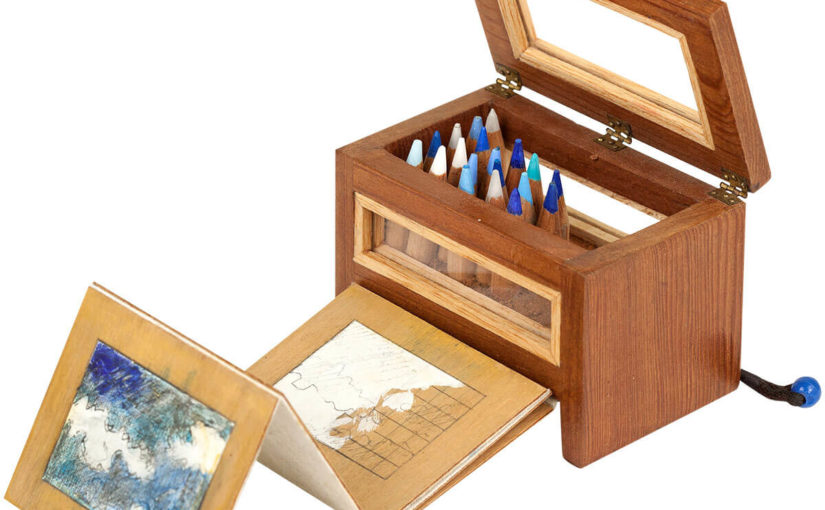
Bush Box
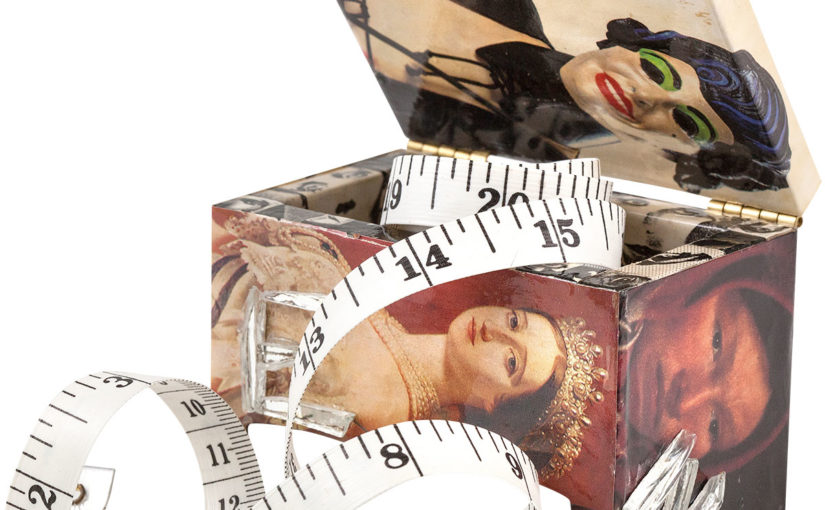
We Are This and That and Everything In Between
Ironically, rather than dealing with the Individual, Western society tends to place us in particular categories (little boxes) and more specifically opposing polarities in order to deal with us more easily, more quickly, less personally.
This easy stereotyping is even more prevalent in regard to the position of women: Madonna/Whore, Mother/Worker, Young/Old, Beautiful/Ugly, Nature/Culture. This box contains references to the stereotyping that we as women experience and the title, We are This and That and Everything in Between, refers to the true individual nature of the female sex.
The Women’s Voices: Diana Robson from WOMEN BEYOND BORDERS on Vimeo.
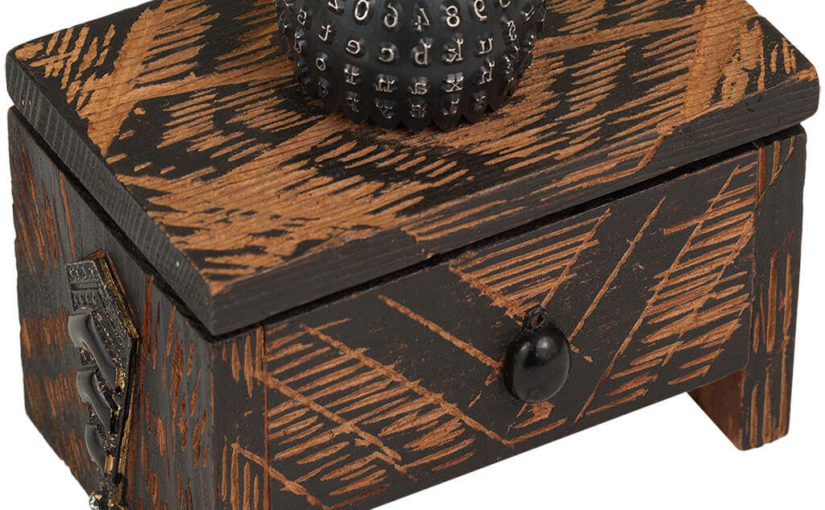
Pressing Issues
In the tradition of the found object and the democratic processes of making and distributing art, I have made a mini printing press out of my cedar box. The box is now a stamp with a pad inside the box with pressing issues waiting to be revealed.
• Who controls female fertility?
• What happens to all the women and children who are refugees?
• Can women artists maintain careers into old age?
Therese Kenyon, Australia – Director, Manly Art Gallery from WOMEN BEYOND BORDERS on Vimeo.
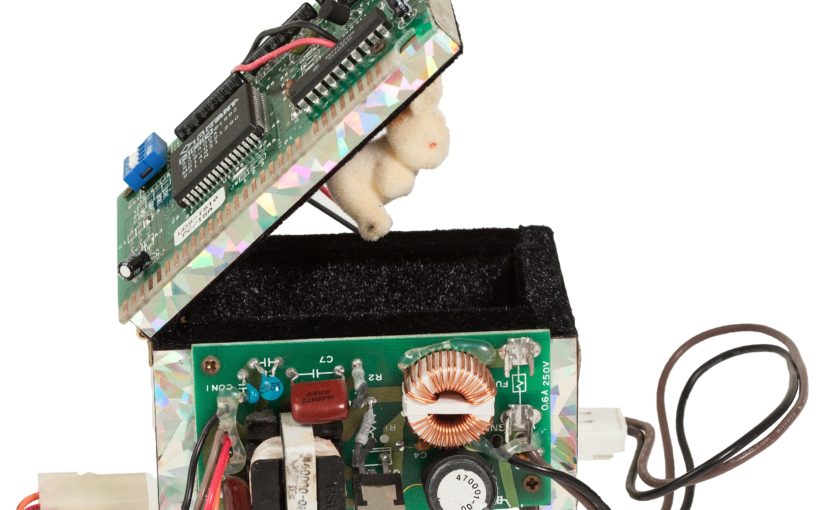
Magic Box
Covered with computer motherboards, connecting wires and glittering holographic stickers, harbors a rabbit inside, the oldest trick in the book. The rabbit represents the ambiguous nature of technology, simultaneously creating fantastic and magical results, while conversely negating magic and myth through infinite research and explanation of detail.
The march of technology is rampant, and it would be foolish not to become involved. Considering its widespread implications for the future, it offers a Pandora’s Box hope to potentially help the world through science, medicine, information, etc.
Changes will come just as they always have, only with lightning speed. Time for contemplation is scarce, but it is nevertheless necessary, for we don’t want to find in the end that the magic tricks which technology promises are simply the same illusions which have clouded our visions in the past.
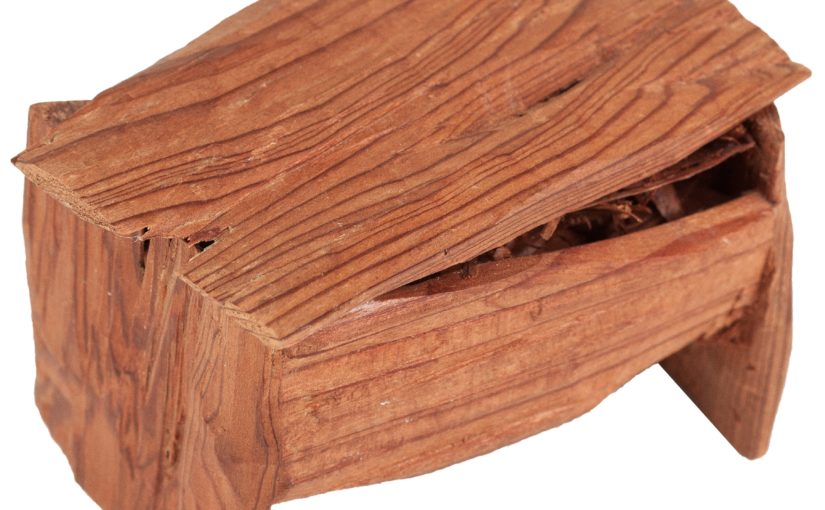
Whittle Box
My whittle box was created in a moment. I wanted to express through the box something which was inherent about my life as a woman now.
When I began the box, I was looking after a recent exhibition. With time on my hands and feeling at ease and relaxed, I began to craft the box carefully smoothing the edges and finely sanding the surfaces.
I put the box away, took my exhibition to another state and on my return found myself overwhelmed by things to do. Every one wanted a piece of me and I wanted to do it all, but I found myself being whittled away, becoming more fragile with each passing day. I carried my whittle box around with me everywhere, waiting for an opportunity to work on it.
Finally after finding myself locked out of a premises one day tired and frustrated, I took my whittle box out of my bag and began whittling and stuffing the wood shavings back into the box the way I wanted to try and renew myself. After a few hectic minutes of total expression I fell asleep.
My whittle box is an expression of the frustration and fatigue felt by those who give until it hurts, stretch themselves to the limit and find that sometimes, they lose sight of themselves.