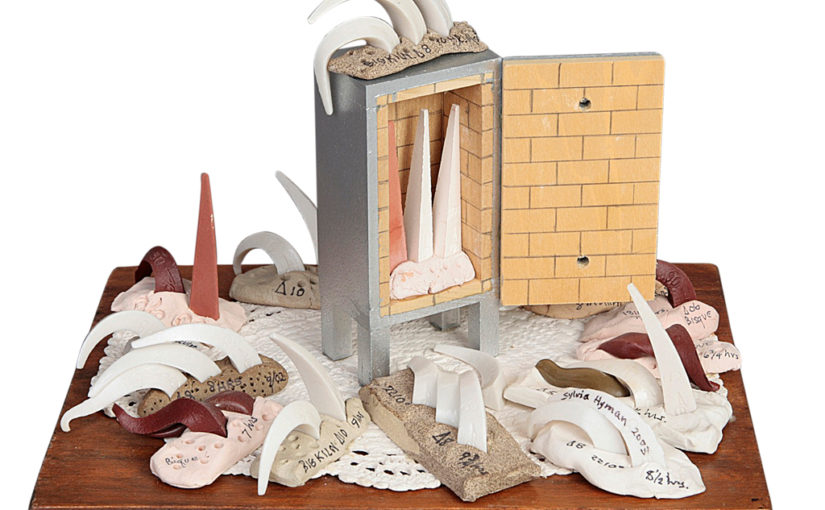
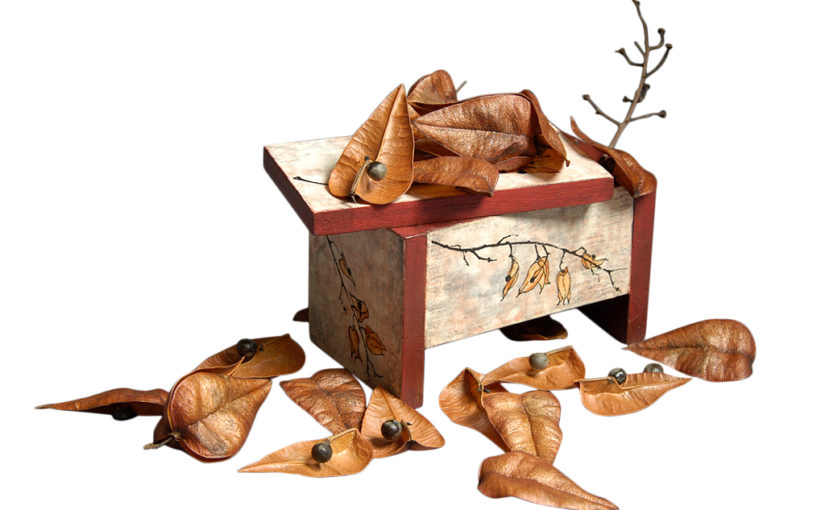
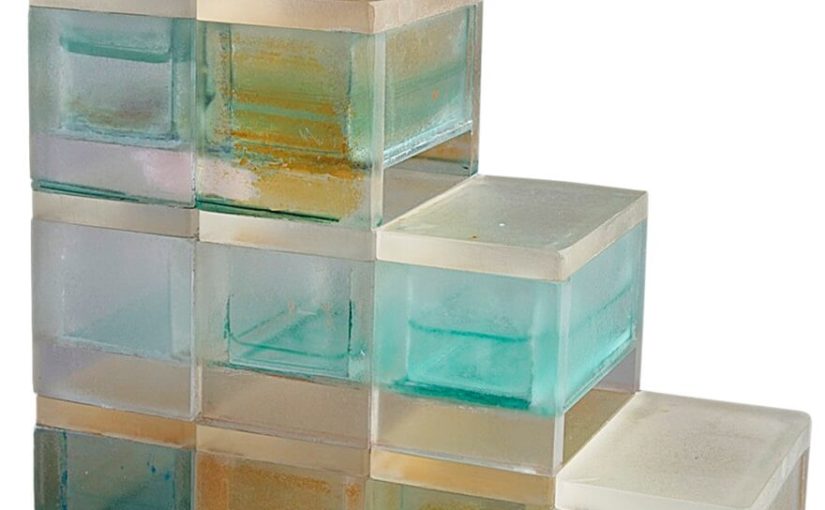
Pyrometric cones play an important role in the process of making my ceramic sculpture. Although there are sophisticated instruments to measure temperature in a kiln, the cones are a more reliable indicator of the effect of TIME and HEAT on ceramic materials. The simple cone-shaped forms, each calibrated to melt at a specific temperature, can be observed through a peephole in the kiln door during a firing. As the cones bend, their reaction to the advancing temperature indicates how my sculpture is reacting.
My box represents my kiln, surrounded by previously fired “cone-pats”. It is mounted on a porcelain doily that symbolizes the interaction between my life as an artist and my rich, full domestic life.
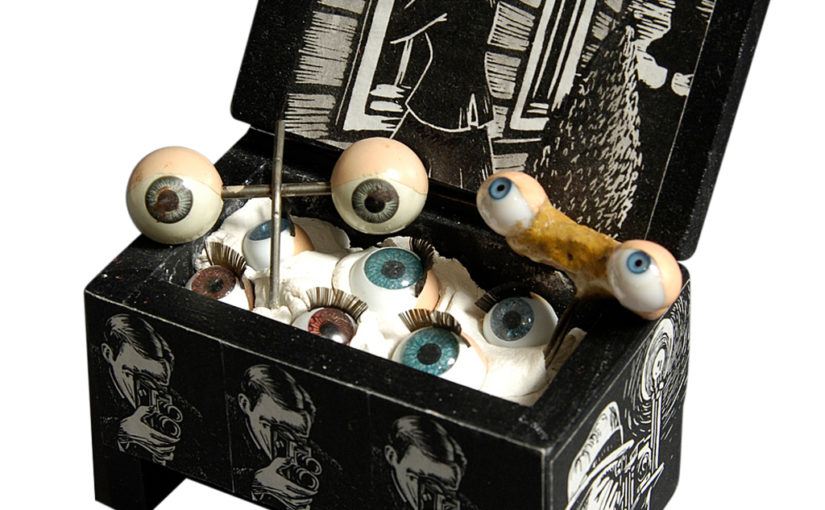
The images on my box are from a series of relief prints in response to the U.S. Attorney General’s “TIPS” program. The program recommends that citizens keep an eye on one another and then inform the government of any suspicious activity. As disembodied doll eyes peer out from the inside of the box, images of men and women watching in various ways surround the exterior.
“This world is a tree to which we cling–
we, the half-ripe fruit upon it.
The immature fruit clings tight to the branch
because, not yet ripe, it’s unfit for the palace.
When fruits become ripe, sweet, and juicy,
then, biting their lips, they loosen their hold.
When the mouth has been sweetened by felicity,
the kingdom of the world loses its appeal.
To be tightly attached to the world is immaturity;
as long as you’re an embryo,
blood-sipping is your interest.”
– Mevlana Jalaluddin Rumi
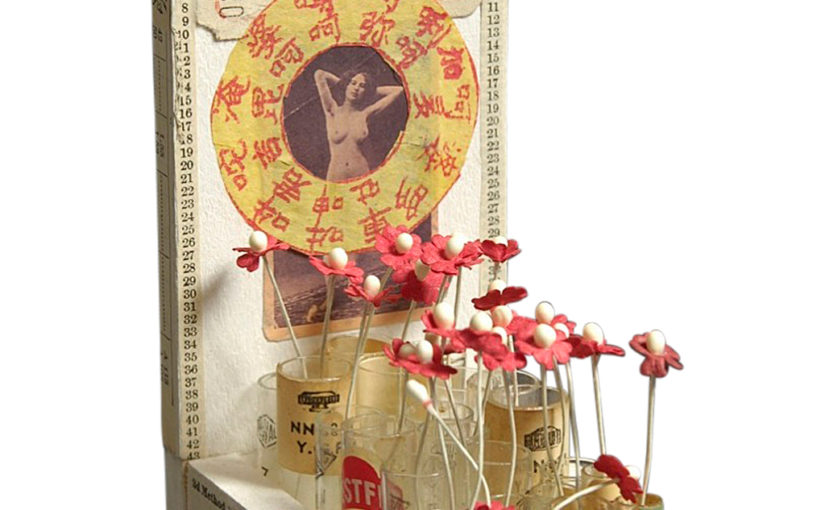
A fascination with seeds, seed pods, fruit of both tree and vine accompanied my own struggle with fertility. What appeared to be fallow in my life gradually evolved into a period of regeneration and rebirth. At present, these familiar forms reflect the renewal of my work and symbolize the opaque and marvelous mystery of the human life.
This box is lovingly dedicated to Mary Interlandi: May 20, 1983 – February 10, 2003
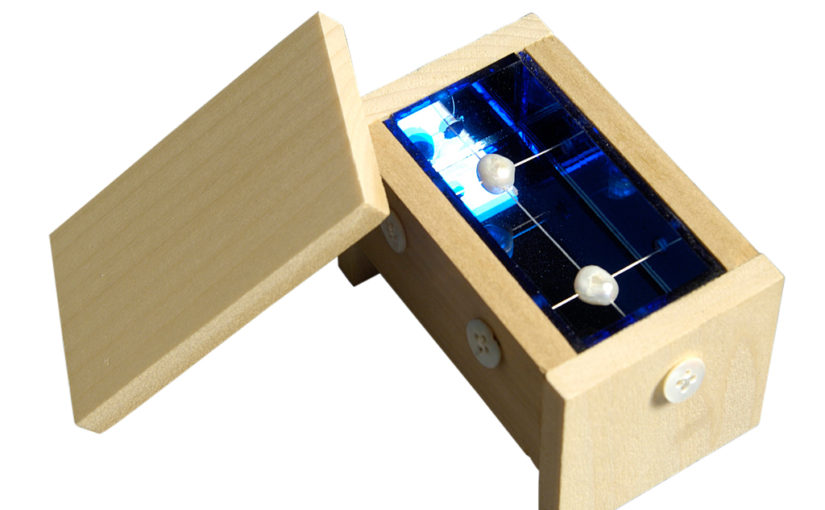
“In the heaven of Indra, there is said to be a network of pearls so arranged that if you look at one you see all the others reflected in it. In the same way each object in the world is not merely itself but involves every other object and in fact is everything else.”
– Translated by Sir Charles Eliot from the Avatamsaka Sutra, approximately 500 BCE
Lorraine Serena furnished the box
Julie Coale suggested these pearls
Sylvia Hyman recommended Sherry Male for drilling them
Tyree McFarland provided the silvered glass and the glasswork
Daisy gave me the idea for suturing thread
Dr. Dee Dee Fredin supplied it
Dixie Gamble manifested the replacement glass
and Jane Braddock buttoned it up
women’s network.
Chase Rynd, Executive Director
Mark Scala, Curator
Katie Welborn, Associate Curator
Dr. Pedro and Dr. Priscilla Garcia, Coordinators
THE MUSEUM EXHIBITION
“The works are extraordinary and provocative,” Frist Museum curator Marka Scala said. “Some art is a little bit difficult to connect with, but in this case, the connections are going to be so immediate. This exhibit gives us the opportunity to think about women and girls in Nashville and in a way broader international context.”
Dr. Priscilla Garcia and Dr. Pedro Garcia
The WBB exhibit was introduced to the Frist Museum by Dr. Priscilla Partridge Garcia, a psychologist and professor married to Metro schools Director Pedro Garcia. Dr. Pedro Garcia later introduced the Metro Schools to WBB. The exhibition drew a record 52,000 viewers, the largest turnout to an exhibition in the museum’s history. When asked about the exhibition, its founder Lorraine Serena said that “The collection has sparked the growth of a new community of artists and has become a virtual launchpad from which artists and viewers can progress together with a greater understanding of each other’s struggles and achievements. This community is invaluable because it provides a place in which their voices can be heard. Also, the women feel empowered by the worldwide reception of the art and by the local communities they form. The boxes not only evoke personal, emotional and thoughtful responses from their audiences, but they also convey the beliefs of the individual artists.”
WBB Artists with Lorraine Serena
ADJUNCT PROJECTS
The Frist Center for Visual Arts encouraged adjunct projects, including 1,000 teachers and students from the Nashville School District and other various groups. Workshops were held at the Renewal House and Magdalen House, recovery communities for women and their children who are suffering from alcohol, drug abuse, and prostitution. In addition, Nashville’s Rites of Passage, Hermanitas and Girls Scouts expressed their ideas and visions through personal boxes. Watkins College of Art and Design students joined in with their own creations and displaying them at the college gallery.
Metro Art coordinator Carol Crittenden said, “It’s the concept that is so great, having students be honorary women for the day. As much as anything, the thing I like for the young men, is the viewpoint for them to see it from the women’s perspectives. I’m very interested in all of our children seeing literally outside the box of what our lives and lives around the world are like.”
Elizabeth Mask – Ripened Fruit – Tennessee, 2003
Elizabeth Mask – Ripened Fruit – Tennessee, USA “This world is a tree to which we cling– we, the half-ripe fruit upon it. The immature fruit clings tight to the branch because, not yet ripe, it’s unfit for the palace. When fruits become ripe, sweet, and juicy, then, biting their lips, they loosen their hold. When the mouth has been sweetened by felicity, the kingdom of the world loses its appeal. To be tightly attached to the world is immaturity; as long as you’re an embryo, blood-sipping is your interest.”
– Mevlana Jalaluddin Rumi
A fascination with seeds, seed pods, fruit of both tree and vine accompanied my own struggle with fertility. What appeared to be fallow in my life gradually evolved into a period of regeneration and rebirth. At present, these familiar forms reflect the renewal of my work and symbolize the opaque and marvelous mystery of the human life. This box is lovingly dedicated to Mary Interlandi: May 20, 1983 – February 10, 2003
Lorraine Serena and WBB student participant
GIRL SCOUTS BEYOND BORDERS
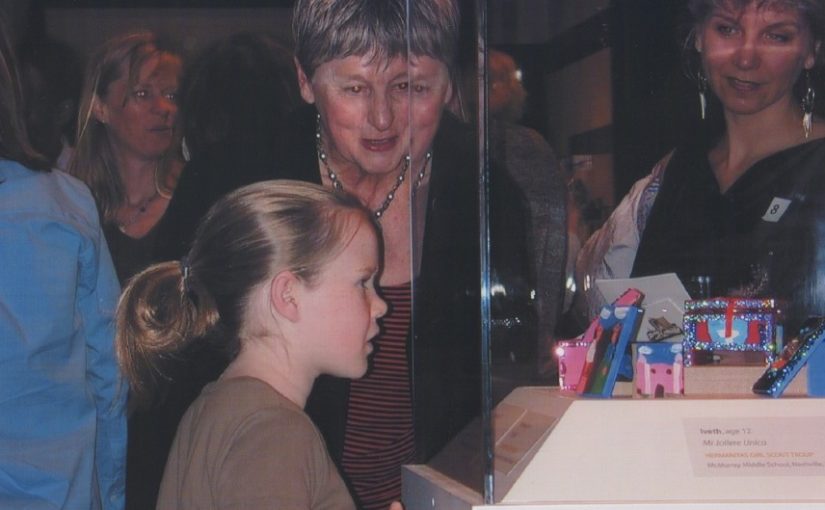
The Frist Center and the Girls Scouts of Cumberland Valley collaborated to extend the Women Beyond Borders exhibition to the Nashville community. Four Girl Scout troops were selected to participate in an outreach program related to the exhibition. Two of the troops, Vine Hill and Magness-Potter Community Centers, were from the Rites of Passage program that provides the Girl Scout experience to girls living in or near public housing developments. The other two troops, McMurray and Glencliff Middle Schools, were Hermanitas troops, in-school programs that match Hispanic girls with bi-lingual adult mentors.
The girls, aged 5 to 13, received identical, miniature wooden boxes (3.5” x 2” x 2”) like those given to the artists in the Women Beyond Borders exhibition. They explored issues relating to their lives, and their boxes were created as statements about themselves. Many girls used their box to tell of their family and cultural background, while others used their box to express things that they loved.
The Women Beyond Borders art project involved women artists around the world in a cross-cultural collaboration honoring creativity and building community through dialogue. The 57 girls from the Nashville Girl Scout troops continued this dialogue through the creation of their boxes.
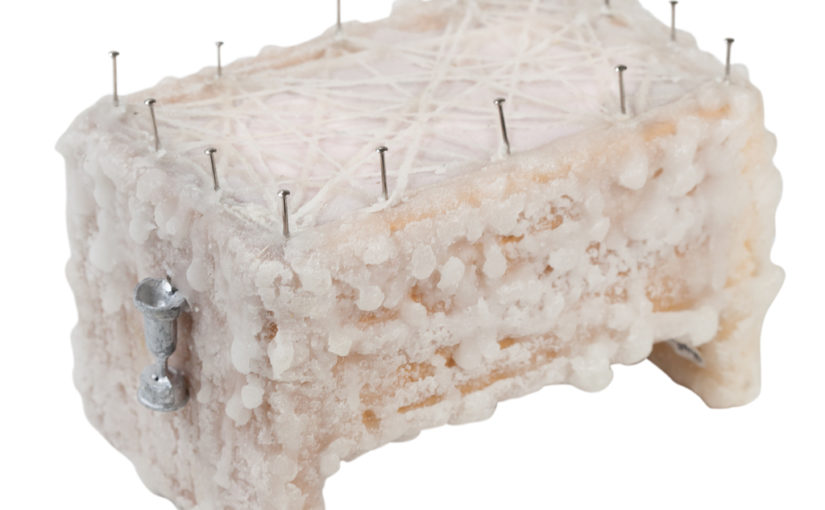
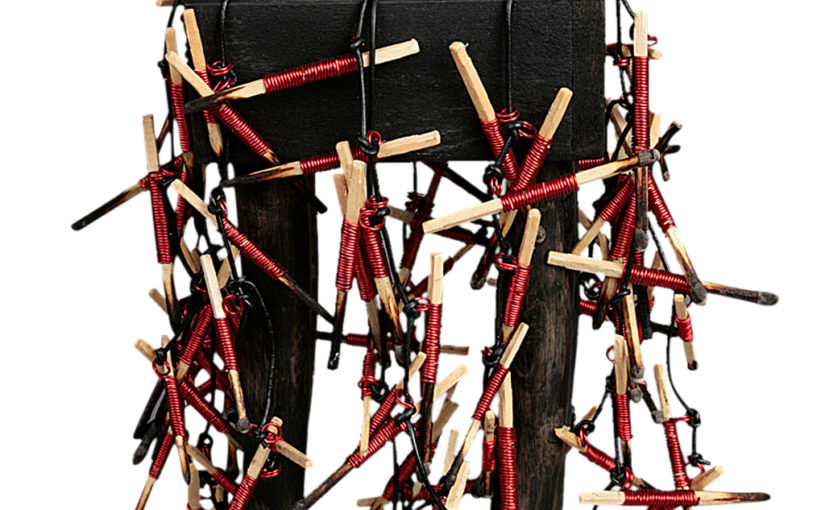
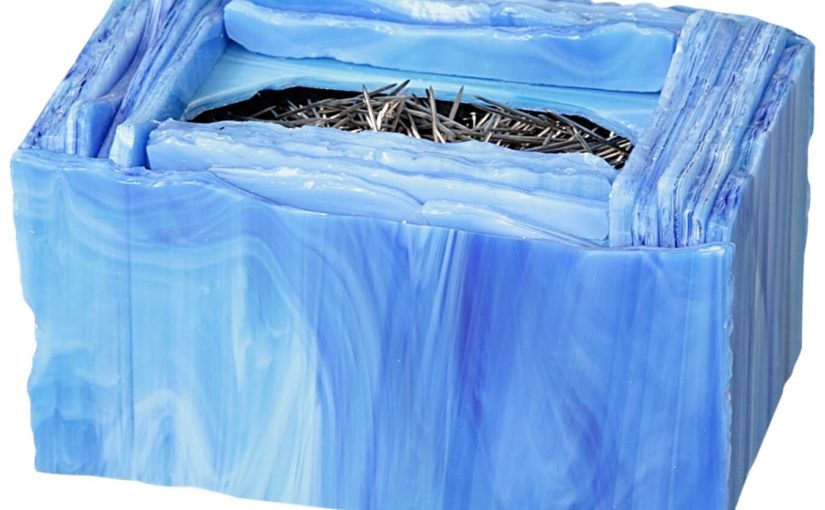
Like most domestic tools, the straight pin is usually considered a useful and innocuous object. I use thousands of them to make aggressive statements referencing handwork, domesticity and the female voice. The finished pieces are beautiful. They are also sharp and dangerous. Like the tiny pins that efficiently perform multiple household tasks, my work suggests more than what meets the eye. “Conflict” physically expresses endured emotional battles.
With my background in fiber art from the School of the Art Institute of Chicago, I am intrigued by the works of George Segal, Edward and Nancy Kienholz, Cathy de Moncheaux, Annette Message, Louise Nevelson, Eva Heese and Ann Hamilton. Finally, the following excerpt, as read not in context, but taken from Anais Nin’s A Spy in the House of Love, 1968, pp. 6-7, sheds light on my ideological treatment of perception.
“She was like an actress who must compose a face, an attitude to meet the day…She must redesign the face, smooth the anxious brows, separate the crushed eyelashes, wash off the traces of secret, interior tears, accentuate the mouth as upon a canvas, so it will hold its luxuriant smile. Inner chaos, like those secret volcanoes which suddenly lift the neat furrows of a peacefully plowed field, awaited behind all disorders of face, hair and costume, for a fissure through which to explode.”