Diep Vuong, Co-Founder and President Pacific Links Foundation
Patricia Nguyen, Art Coordinator
Vanessa Tantillo, Consulate Officer
Stephania Serena, Contact
SURVIVORS OF HUMAN TRAFFICKING
Building Blocks: Life Skills, Art, and Healing
Building Blocks: Life Skills, Art, and Healing, was a project spearheaded by Pacific Links Foundation and funded in part by the Consular Club of Ho Chi Minh City in Vietnam to support the reintegration process of survivors of human trafficking. The three day intensive project was held in Mui Ne, a local beach town that allowed the young women from PALS’ Southern Shelter to distance themselves from their current environment and gain perspective and reflect.
The Northern Shelter residents also participated in a separate session with similar goals. With the goals of self-development, reflection, healing and reintegration, the project focused on helping trafficked returnees rebuild their lives through art. Through creative arts workshops, as well as individual and small group sessions, the project focused on building healthy self-esteem and healthy relationships.
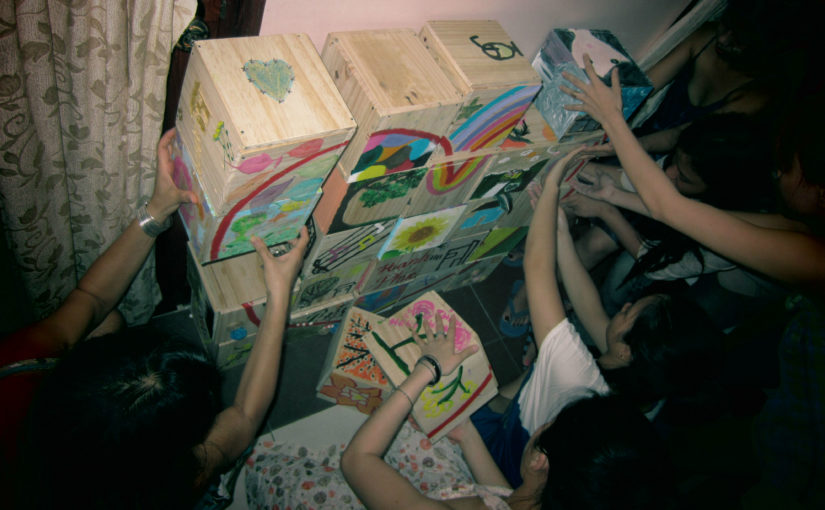
The young girls started off with wooden boards and nails. They worked together to build boxes, paint them, and assemble them into a collaborative mosaic, symbolizing the individuality of each woman and the interconnectedness of their journeys together, to rebuild a new life.
Betsy Kain, Coordinator Rita Rivest, Coordinator Pat McClure, Contact
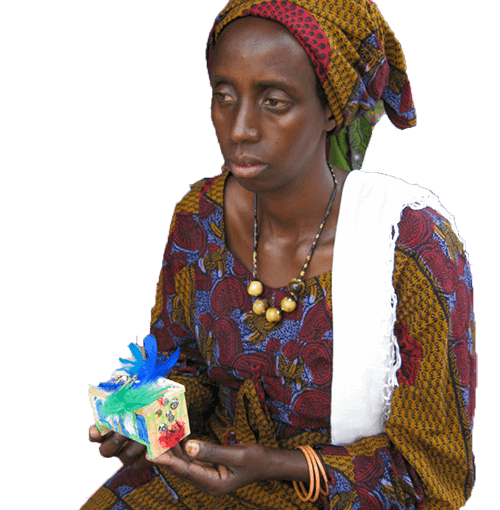
This group of boxes is part of 55 boxes that were taken to Kigali, Rwanda by Betsy Kain in collaboration with Solace Ministries in 2006. They were given to widows of the genocide in an effort to help them work through their losses and grief. The transformed boxes and statements reflect the atrocities and immense personal hardship Tutsi women went through, and their attempt to cope with memories of their loved ones being killed in front of their eyes.
Pat McClure, Betsy Kain, and Rita Rivest
Women of Rwanda expressing their creativity and emotions through their boxes as part of a healing exercise
Beatrice Nicyascra – Beatrice’s Box, A Coffin – Rwanda, 2006
Beatrice Nicyascra – Beatrice’s Box, A Coffin – Rwanda
The figures on the top represent her husband and four children who were all murdered during the genocide. She had to (forced) watch, as her husband was hacked into four or five pieces. Overwhelmed with tears, she could not go any further.
Annie Mbabazi – Untitled – Rwanda, 2006
Annie Mbabazi – Untitled – Rwanda Green, yellow and blue are the colors of our flag. Rwanda, a nation recovering from the blood shed of man. The red doom is the symbol of Genocide and the white cross with the bleeding heart of Jesus, who sacrificed that Rwanda be made clean, symbolized by the white cross.
Yellow is sunshine, hope for Rwanda. Green is life and growth and blue is reconciliation, possible only though the blood of Jesus.
Chase Rynd, Executive Director
Mark Scala, Curator
Katie Welborn, Associate Curator
Dr. Pedro and Dr. Priscilla Garcia, Coordinators
THE MUSEUM EXHIBITION
“The works are extraordinary and provocative,” Frist Museum curator Marka Scala said. “Some art is a little bit difficult to connect with, but in this case, the connections are going to be so immediate. This exhibit gives us the opportunity to think about women and girls in Nashville and in a way broader international context.”
Dr. Priscilla Garcia and Dr. Pedro Garcia
The WBB exhibit was introduced to the Frist Museum by Dr. Priscilla Partridge Garcia, a psychologist and professor married to Metro schools Director Pedro Garcia. Dr. Pedro Garcia later introduced the Metro Schools to WBB. The exhibition drew a record 52,000 viewers, the largest turnout to an exhibition in the museum’s history. When asked about the exhibition, its founder Lorraine Serena said that “The collection has sparked the growth of a new community of artists and has become a virtual launchpad from which artists and viewers can progress together with a greater understanding of each other’s struggles and achievements. This community is invaluable because it provides a place in which their voices can be heard. Also, the women feel empowered by the worldwide reception of the art and by the local communities they form. The boxes not only evoke personal, emotional and thoughtful responses from their audiences, but they also convey the beliefs of the individual artists.”
WBB Artists with Lorraine Serena
ADJUNCT PROJECTS
The Frist Center for Visual Arts encouraged adjunct projects, including 1,000 teachers and students from the Nashville School District and other various groups. Workshops were held at the Renewal House and Magdalen House, recovery communities for women and their children who are suffering from alcohol, drug abuse, and prostitution. In addition, Nashville’s Rites of Passage, Hermanitas and Girls Scouts expressed their ideas and visions through personal boxes. Watkins College of Art and Design students joined in with their own creations and displaying them at the college gallery.
Metro Art coordinator Carol Crittenden said, “It’s the concept that is so great, having students be honorary women for the day. As much as anything, the thing I like for the young men, is the viewpoint for them to see it from the women’s perspectives. I’m very interested in all of our children seeing literally outside the box of what our lives and lives around the world are like.”
Elizabeth Mask – Ripened Fruit – Tennessee, 2003
Elizabeth Mask – Ripened Fruit – Tennessee, USA “This world is a tree to which we cling– we, the half-ripe fruit upon it. The immature fruit clings tight to the branch because, not yet ripe, it’s unfit for the palace. When fruits become ripe, sweet, and juicy, then, biting their lips, they loosen their hold. When the mouth has been sweetened by felicity, the kingdom of the world loses its appeal. To be tightly attached to the world is immaturity; as long as you’re an embryo, blood-sipping is your interest.”
– Mevlana Jalaluddin Rumi
A fascination with seeds, seed pods, fruit of both tree and vine accompanied my own struggle with fertility. What appeared to be fallow in my life gradually evolved into a period of regeneration and rebirth. At present, these familiar forms reflect the renewal of my work and symbolize the opaque and marvelous mystery of the human life. This box is lovingly dedicated to Mary Interlandi: May 20, 1983 – February 10, 2003
Lorraine Serena and WBB student participant
GIRL SCOUTS BEYOND BORDERS
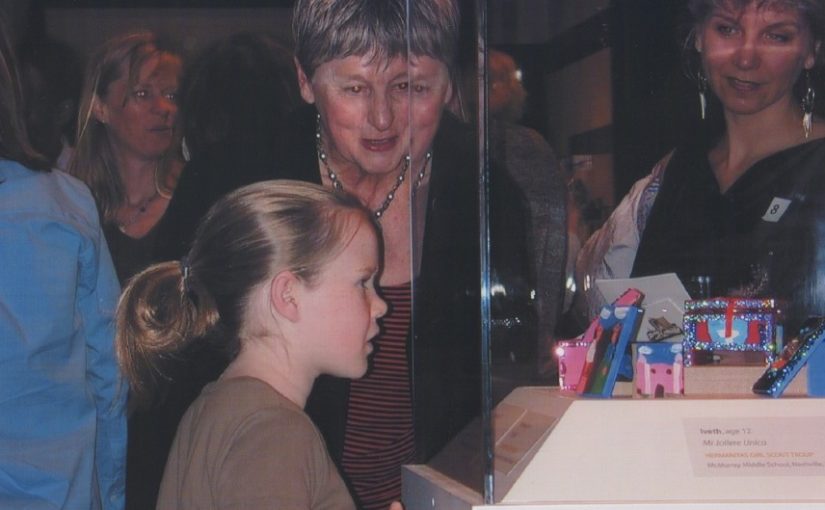
The Frist Center and the Girls Scouts of Cumberland Valley collaborated to extend the Women Beyond Borders exhibition to the Nashville community. Four Girl Scout troops were selected to participate in an outreach program related to the exhibition. Two of the troops, Vine Hill and Magness-Potter Community Centers, were from the Rites of Passage program that provides the Girl Scout experience to girls living in or near public housing developments. The other two troops, McMurray and Glencliff Middle Schools, were Hermanitas troops, in-school programs that match Hispanic girls with bi-lingual adult mentors.
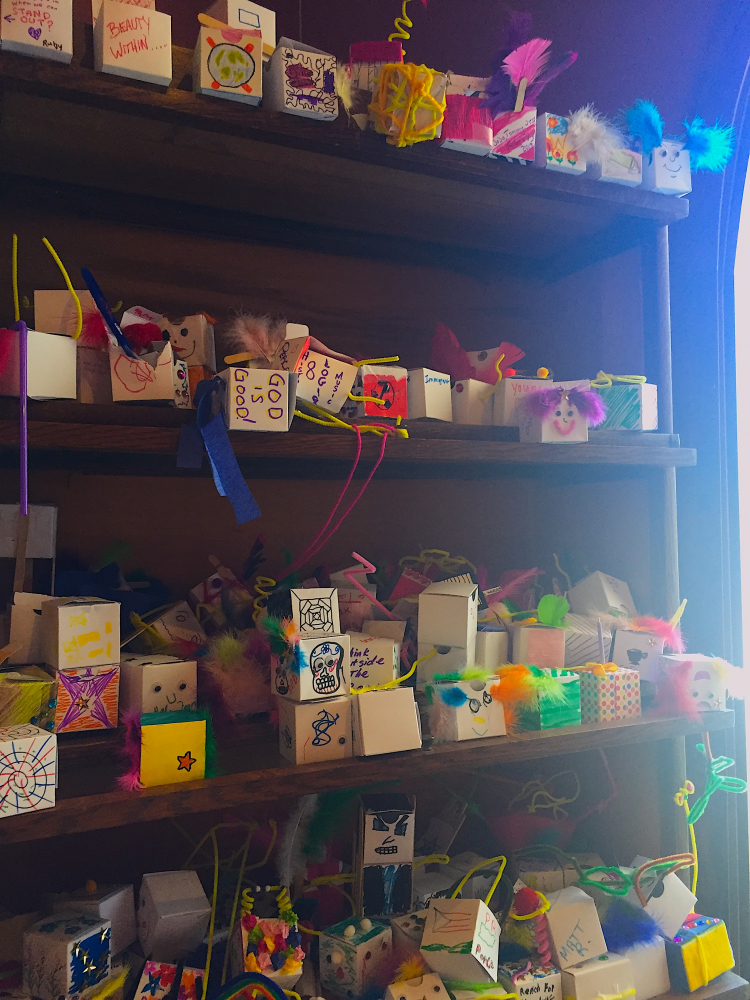
The girls, aged 5 to 13, received identical, miniature wooden boxes (3.5” x 2” x 2”) like those given to the artists in the Women Beyond Borders exhibition. They explored issues relating to their lives, and their boxes were created as statements about themselves. Many girls used their box to tell of their family and cultural background, while others used their box to express things that they loved.
The Women Beyond Borders art project involved women artists around the world in a cross-cultural collaboration honoring creativity and building community through dialogue. The 57 girls from the Nashville Girl Scout troops continued this dialogue through the creation of their boxes.
Christine Scott, Girls Inc. Program Director, Art Therapist
Jody Nelson, Girls Inc. Program Director, Filmmaker
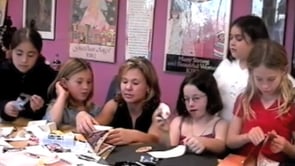
Women Beyond Borders collaborated with Girls Inc. at the Ten-Year Retrospective in 2002. Girls Inc. held workshops where young students created boxes that were exhibited at the WBB exhibition. Christine Scott worked throughout the program to empower young girls to tell their truth through art. After the program was completed the girls were encouraged to keep their boxes as reminders of their powers of self-expression. Below are a few heartfelt statements the girls wrote to describe their boxes.
A pair of young artists with their boxes and their teacher at the exhibition
Emmaly Read, Age 8 – Court – California, USA I was thinking about how a judge who doesn’t know me, my dad or my mom changes my whole entire life in a few minutes. I think if you live with your mom, you should get to still see your dad every few weeks, and if you live with your dad, you should still get to see your mom every few weeks. I don’t like how you can never see your dad or mom again because some judge says that. Judges should have to learn how to meet somebody before they judge them.
Breanna Maxwell, Age 10 – Nothing, Something – California, USA My box is about being a girl who doesn’t have a dad who lives with me and who has a dad that lives in a car and doesn’t live in a house. My dad doesn’t have a house, he has a car as a house. He made the wrong decision. It is his fault but the devil just made him. He made a very, very, very, very dumb decision. It sometimes feels like I have a dumb dad.
Rebecca Ramos, Age 10 – A Mess – California, USA My aunt says that girls in Mexico start cleaning when they are 5. They clean because their parents have to work. I have to clean a lot because my mom isn’t there. I have to wash the dishes and take out the garbage and clean the bathroom and get my sister ready for daycare and clean our room. (Sarah helps me) I wish everybody in my family would pick up their mess instead of me cleaning it.
Girls Inc. Program Film by Jody Nelson
Christine Scott and her students view the original boxes at Lorraine Serena’s studio