April 1975, Vietnam: Everyone knows the communists will overrun Saigon, but no one expected it to happen so fast. Over the last month the sound of gunfire and explosions have slowly increased in frequency and force. We are so used to it that it has become a sort of background noise no one pays any attention to. Despite this I remember waking on April 30th, alarmed at how close the sound of gunfire and explosions was to our neighborhood. The city was in chaos, dark smoke blanketed the horizon as people ran with whatever belonging they could carry. But as I watched it seemed that very few had any idea of where to go.
My family and I hurriedly packed some clothes and fled to a friends house in another part of the city called Cho-Lon which was safer. We could no longer stay in our home because it was near an army camp and therefore dangerous. My father was not with us because he and my mother had separated years earlier. Adding to our anxiety was a rumor that the communists have threatened to flatten Saigon if there is resistance. By noon the presidential palace had fallen and we knew it was all over. I was only 7 years old at the time and did not realize how bad the situation was, so I innocently told my mom that now Vietnam will be one country again so she can go back to North Vietnam to see grandmother. My mom was delighted with the thought.
Later that afternoon we drove to the harbor to see what was going on since the radio station had been captured by the communists and we no longer were getting any news. As we drove around the streets were now completely deserted and an strange silence had fallen on the city. The only people we saw were a few people left still burning records and documents in front of some government and military installations. More ominous was the fact that in the harbor most of the navy and merchant ships had already left. I asked my mom what was going on but she seemed lost in her thoughts, maybe she was thinking of the harsh choice she would soon have to make.
My uncle and his wife had been staying one step ahead of the communists since they fled the central highlands. Because of the speed of the communist advance, the roads were jammed with refugees fleeing south making progress impossible for vehicles. Even though they did not want to be separated, my uncle was forced to put his wife on one of the boats heading to Saigon because she was pregnant and would never be able to keep up on foot. When he finally made it to Saigon a few weeks later, he found out that his wife has not arrived and not knowing where she was or what else to do, decided to stay with us in hope that she would find him. Later we learned that the boat she was on had unexpectedly dropped everyone, including his wife, off at Cam Ranh Bay (another city in the central highlands) to go back north for more refugees. My poor aunt was unable to find a way to get to Saigon until after the fighting was over and escape was impossible.
Meanwhile for the rest of us, time was running out. We knew that if we were going to leave it had to be now. We waved down one of the few remaining navy boats which was headed out to sea but stopped to pick us up. At this time not everyone was willing to escape by boat so while it was crowded, there was none of the panic and fighting such as I saw in the photos taken at the American Embassy that day as the last helicopters were leaving. The gun-fire was getting closer and my uncle was torn between staying to look for his wife and escaping, he was worried that he and his wife would face retribution if he stayed because he had been in the army. My mother was hesitant to get on board because she had to choose between leaving with us or staying so that she could see her mother for the first time since 1954 when North and South Vietnam were separated. Finally she decided to stay and promised to find us after the war ended. As the boat pulled away I can still remember my mother standing on the dock, crying and waving to us. I was yelling, “Stop the boat, go back and get my mom”, but it was too late. In those few minutes my family was torn apart and for last time I saw Vietnam. As my mother watched the boat leaving with her children she was overcome with grief and changed her mind. Desperately she stood at the dock for five hours waiting for another boat to take her out to our ship, but none came.
On the way out of Saigon, we saw hundreds of returning boats and some of them warned us not to go on because troops were shooting at any boats trying to escape to the open sea. The people on our boat were very determined and decided to take their chances and leave.
Many of the boats we saw leaving were severely overloaded and one of the ships had run aground in shallow water. Our smaller boat pulled alongside the old, rust streaked ship and an agreement was reached that everyone who wanted to could transfer from our boat to the ship, and in return our boat would help pull the ship into deeper water. After struggling for three or four hours both vessels finally reached deep water and all passengers were transferred. The small boat turned back toward Saigon, taking a few people who had changed their minds and decided to go back. The ship, even more overcrowded than before slowly headed out to the open ocean for the long dangerous voyage ahead. Even though we had made it out of Saigon there was no celebrating, everyone was dwelling on what they had left behind and what the uncertain future would hold. That night was pitch black, there were no lights on our ship or on shore. We watched fireworks shooting up from the coastal villages into the dark sky. The communists were celebrating their victory and we could hear one of the generals broadcasting a new set of rules which he called ” the ten commandments “. These commandments were to govern life for those left behind in the new Vietnam. Our intended destination was Singapore and we slowly headed south. The weather was good and if it were not for the grim circumstances I might have been able to appreciate the beauty of the blue ocean and the small islands we passed. Once we saw some whales which terrified everyone because they were nearly as large as our ship and came very close. When I look back on the event, I think that everyone leaning over one side to watch the whales was more dangerous to the ship than the whales themselves.
Things started to go seriously wrong a couple of days into the journey when our engine broke down. I guess this was not very surprising considering how old and decrepit our ship was to start with. There were many more small boats from coastal villages followed us and dumping refugees onto our ship each day. The water started to coming in from an existing hole on the side of the hull of our ship which is now below the waterline because of the refugees’ weight. After drifting a few days, our food and water were running out, making an already bad situation very desperate. People started to fight over food and water. Everyone was being very careful to ration their water and food except for this popular singer from Saigon who would use a great deal of her small supply of water to wash her face each day. Obviously some people are more afraid of being unattractive than dying.
Everyone thought that we were going to die slowly and horribly, despair settled over the ship like a numbing fog. A man near me decided not to wait and shot himself in the head. I remember screaming when his blood and brain tissue splattering on me. On the crowded deck there was no where to store the body so there was no choice but to toss his body overboard and within minutes the sharks were fighting over it. As days passed, so great was my fear and loss that I felt neither hunger or thirst. My mind had cut off my ability to feel or comprehend what was happening around me, which was maybe a good thing considering what life was like onboard. Even though the ship was extremely overcrowded there was very little talking, everyone seemed wrapped up in their own misery. My brother and sister sat nearby crying and hugging each other. The crowding was so great that one night when I stood up to stretch, I found that I could no longer find a space to sit back down so I ended up standing the entire night until I collapsed. Having learned my lesson I did not get up again until we were rescued.
Despite our SOS signals and desperate attempts to get their attention, many ships passed us by without stopping but finally after floating what seemed like forever we were picked up by a Danish freighter out of Thailand on their way to Hong Kong. After being left by so many other ships, everyone was afraid that if we did not get onboard the freighter fast enough they would leave without us. Most of the people started to panic and there was a lot of pushing and shoving to get on board. Some fights even broke out and many passengers left their personal belongings behind in the mad rush. One man’s leg got crushed between the two ships when they collided into each other. Many others fell into the water and drowned during the rescued. By the time we were rescued, I could not move my legs because of sitting in one spot for so long, I had to be carried up to the freighter by one of the ship’s crew. That night as I was resting from my ordeal someone stole all the cash and jewelry that my mother had given me.
So when it was over all I had left of Vietnam were memories of people and places that had been left behind. For many years afterward, I would get angry when I thought about what had happened and what I lost. I was not angry at anyone in particular, rather I was angry how events and ideologies which I did not understand could take me from everything I knew and loved. After my mother and other members of my family have moved here recently, I finally have the chance once again to know the family I lost twenty years ago.
Women Beyond Borders is a cross-cultural women’s art project initiated with the goals of documenting women’s voices and visions, encouraging collaboration and community among women, creating an international dialogue, and honoring women’s artistic creativity worldwide.
Over the past decade, Women Beyond Borders has developed into one of the most intriguing and inspiring cultural phenomena at the turn of the twenty-first century, successfully reaching out to large and diverse audiences internationally and challenging national, political, ethnic, religious, and aesthetic boundaries. As guest curator of the project’s ten-year retrospective Women Beyond Borders: The Art of Building Community, organized by the UCLA Fowler Museum of Cultural History and the University Art Museum of the University of California, Santa Barbara (2001/2002), I want to review some of the project’s implications for today’s feminist (art) practices, its role in fostering personal expression and transformation, as well as cross-cultural and global understanding.
Women Beyond Borders was founded in 1991 by Lorraine Serena and Elena Siff, together with a group of local artists and art professionals in Santa Barbara, California. The vehicle which the group chose to reach out to women internationally was a small wooden box – evocative of a vessel, womb, tomb, gift, shrine, or hope chest. The box was not only found to be a powerful symbol for women, but it could also be shipped inexpensively around the world.
Originally, in the early 1990s, 200 copies of a simple prototype were sent to female curators and artists in fifteen countries. Each participant received an identical miniature wooden box with a lid, measuring 3 ½ in. x 2 in. x 2½ in (c.9 cm x 5 cm x 6.2 cm). Participants were asked to transform these boxes using paint, sculptural objects, photographs, text, textile and any other materials they deemed fitting. Up to today, the boxes sent out to participants by Women Beyond Borders have these same measurements and come with the same guidelines.
The completed boxes reflect a wide range of artistic styles and concerns. Their form and content ranges from abstract and conceptual to narrative and folkloric. Whatever the style, the meaning of the transformed boxes exceeds their modest size. Not only have they become repositories for the creator’s individual aesthetic expression but many of them also reflect personal, political or economic realities experienced by women worldwide. The written statements, which accompany many of the boxes, speak about, either a woman’s artistic concerns, her personal hardships, her social situation, or the political situation in her country.
In 1995, the Santa Barbara Contemporary Arts Forum hosted the first exhibition of 185 boxes. The exhibition then traveled to venues in the participating countries, including countries such as Cuba and Russia. Along the way, more boxes were added. Since then, Women Beyond Borders has drawn international attention and momentum. Today, more than 900 hundred participants from 45 nations, from Argentina to Zambia, have transformed the miniature boxes into elaborate artworks for Women Beyond Borders. They have ranged from accomplished, nationally and internationally known artists to women with no prior artistic experience. Several dozen curators from different countries have organized over thirty exhibitions of these boxes on all continents, in places as diverse as the National Museum of Kenya, a mall in Toronto, a restaurant in Zagreb, at Ontario International Airport, and at the winter Olympics in Salt Lake City, in addition to numerous art galleries.
Women Beyond Borders is not simply an exhibition – packed, shipped, installed, and opened – it comes with the social imperative to connect women. Organizers in each country hosting an exhibition have taken on diverse challenges to meet that imperative. For example, in Jerusalem (1996), boxes were exhibited during an International Women’s Day celebration. In Basel, Switzerland (1996), boxes were shown in conjunction with Pandora, an exhibition featuring objects from ancient Greece. In Oaxaca, Mexico (1998), they were part of a women’s health program. Boxes were taken on a trek to rural Nepal (1998) by a group of California women, to help educate Nepalese women about health care, domestic violence, and human rights. In 1996, a group of artists from Austria installed a show of boxes in a Russian sleeper car and made it accessible to the public en route, traveling from Graz to St. Petersburg, via Vienna, Budapest, Lvov, and numerous towns in Lithuania, Latvia, Estonia, and Russia. Thus, the exhibition literally crossed borders, as the train car – a box itself – was turned into a moving gallery. These examples highlight the diverse “uses” to which Women Beyond Borders has been put.
Even though the international traveling activity of the hundreds of boxes in the care of Women Beyond Borders has been on hold for administrative reasons since a very successful show in Singapore in 2001, exhibitions in the United States are still organized. Further, the artistic director of the project, Lorraine Serena, is in the process of finding a permanent exhibition opportunity or curatorial agency that would showcase the boxes – or part of them – in a professional and widely accessible environment. However, the concept of the project continues to be very alive in different parts of the world. For example, just recently, a woman from Ulaanbaatar, Mongolia, contacted the Santa Barbara founders asking for financial support to do a box project in her community to deal with violence against women and issues of sexual harassment. Women Beyond Borders has also lent an inspiring hand to new projects, such as the International Museum of Women in San Francisco, which recently invited ‘young women in their twenties and thirties from every corner of the globe to submit their stories and art’.
Wherever the boxes have been shown, the project has acted as a catalyst for cultural activities and exchange. Numerous adjunct events such as satellite exhibitions, panel discussions, symposia, support groups for women artists, school outreach programs, and box-workshops for women, men, and children, were part of most Women Beyond Borders shows. To name just a few examples: in connection with a Women Beyond Borders exhibition in Manly, Australia (1999), a satellite show, Boxes Out Back, was organized in the remotely located community of Broken Hill. It featured boxes by female residents from that community and included a presentation of their boxes to the public. During an exhibition of WOMEN Beyond Borders in Singapore (2001), an adjunct exhibition invited 100 female residents to create a box for 100 Women’s Voices. At the accompanying forum Feminist Consciousness in Singaporean Art, organized by Joyce Fan and Susie Wong, practitioners in the visual, performing and literary arts discussed the question of whether there is a feminist consciousness in art in Singapore.
The stated mission of Women Beyond Borders is to ‘honor and document women’s voices and visions, to build community through dialogue and collaboration, and to inspire all women to express their creativity’. The process of building a global community, I believe, lies at the heart of the project. While Women Beyond Borders rests on actual art objects – the boxes – the project’s uniqueness and one of its strengths, I believe, lies in the vast network its founders and supporters have managed to build all over the world. Lorraine Serena has emphasized that building communities among women has become a substantial aspect of this project and can be considered an art form itself. The exchanges fostered by Women Beyond Borders are documented in endless e-mail messages among participants, in video documentations of gatherings, openings, and workshops, in the quotes by women who have seen the exhibitions worldwide, and in the relationships that have formed because of the project.
Women Beyond Borders has relied on and conceptually integrated new achievements in communication technology, in particular the Internet, from the beginning in order to build a global dialogue among women. Further, a virtual web-exhibition made the boxes widely accessible beyond their international displays (see: http://www.womenbeyondborders.org). This active exchange between women can be considered a form of worldwide happening, along the lines of the much smaller-scale mail art events such as Feministo, created as a life-line among European women artists in the 1970s.
While forming communities among women at any level is an empowering process, creating a positive international dialogue assumes more meaningful implications in a war-ridden, economically imbalanced global society, in which we increasingly share responsibilities as world citizens. Given its US origin, however, the question needs to be asked whether Women Beyond Borders imports and imposes a Euro/American-centered notion of feminist art and feminism. Taking a closer look at this question, which I have done at length elsewhere, I found that while the founder’s inspiration for Women Beyond Borders undoubtedly lies in the history of US and European feminist art and thought, the project itself is non-prescriptive, and it has rather become part of a redefinition of feminism in an international arena.
While I consider further critical analysis and theorizing about Women Beyond Borders in the context of feminist art and globalization a valuable undertaking, I have come to appreciate Women Beyond Borders foremost as a form of hands-on feminism. It is feminism-in-action, internationally and locally. I have come to see this project as a vehicle much more than an agenda, which is an important distinction to make at a time when US-American exports are being scrutinized with increased caution. Women Beyond Borders seems to have been able to touch participants as well as visitors in a unique way wherever it has been “offered”.
As guest curator of the ten-year retrospective of Women Beyond Borders, I have been interested mainly in understanding how this project has connected women internationally. After all, women from countries such as Cuba, Russia, Afghanistan and Iran have contributed boxes to this US-initiated project, a couple of these countries even hosted exhibitions under adventurous circumstances. However, recently, I have been able to explore Women Beyond Borders from another vantage point, other than the curatorial and academic, as an educator. I have come to realize another immanent value of this project, which is found in the creation of the actual boxes.
Much of academic feminist writing – and thinking – seems to have become especially disconnected from the needs of many girls and young women today, or rather, their urgent cries for help. Something which has come forcefully into view through my own work teaching in colleges and raising a teenage daughter. Although feminist artists and critics (including myself) have addressed subjects such as illness, aging, and death, as well as an assortment of sexual orientations and preferences in a courageous way, burning issues that affect girls and young women today seem to hit a blind spot. While, according to statistics, girls finish first when it comes to academic achievement, and we, as feminist mothers and grandmothers can take pride in the “expansion” of their minds, the well-being of their bodies has been vastly neglected. The elaborate theorizing about the female body in feminist theory seems of little actual help when it comes to re-feeding an anorexic 12-year old, moved beyond her senses by self-starvation. Recognizing the very dramatic, very dangerous, and very real problems of a new generation of women and finding fast and effective ways to alleviate them, is, I believe, where feminism needs to be at this point.
From the beginning, Women beyond borders fostered relationships with students from the elementary level through high school and college. Since the late 1990s, the project has been opened up in particular to children and young women through workshops and adjunct exhibitions. When Women Beyond Borders toured Australia in 1999, one of the satellite exhibitions was Grrrls Beyond Borders. Over 200 boxes were created by female high school students from Sydney, which were shown at The University of Sydney’s Tin Sheds Gallery.
For the retrospective of Women Beyond Borders at UCLA and UCSB (2001/2002), we teamed up the project with L.A. and Santa Barbara chapters of Girls Inc., who created their own boxes, which then became part of the retrospective. The personal statements that accompanied each box were direct and compelling: it seemed that for these girls creating a box became a catalyst to work through difficult experiences and emotions. Around the same time, a worldwide daughter-initiative called Children Beyond Borders was launched by the organization Very Special Arts to foster children’s self-expression. It involved about 4,500 children with disabilities from different nations, whose boxes were exhibited for the first time at the Cultural Olympiad in Salt Lake City in 2002.
Recently, I decided to do my own box-assignment in a course I teach on women in the arts at a California State University campus. The task was for the students to enter into a dialogue with a woman from a different culture, century, or country, or with a female artist of their choice. At the end of the course, the students (mostly female, some male) presented to the class their boxes, which they had elaborately transformed at home. The results were beautiful and breathtaking. Some of the boxes were very personal and even included oral history, and it was clear that the project had become an intimate process or journey for the student. Other boxes were tributes to a favorite role model or an important woman of the past. Though this was an art history class consisting of students from a variety of majors, my students were very enthusiastic about this hands-on activity, and I felt it was the most valuable and galvanizing assignment I had ever done.
Women Beyond Borders is positioned at a crucial intersection in today’s art and society; it has been a successful tool in creating meaningful dialogue on several levels – the personal, the local, and the international – and offers us a challenge to how we consider today’s role of art and of feminism, far beyond the box.
I would like to thank Women Beyond Borders for use of their archive, and Lorraine Serena in particular for her continued support of my research, making information about the project available to me and answering my many questions.
Expanding Circles: Women Art & Community – Betty Ann Brown, editor
Lorraine Serena, WBB Artist Founder – USA – 1996
Lorraine in her studio with a collection of her paintings
THE WAY OF WOMEN
Women in communication, sharing ideas, insights, dreams, joys, sorrows and collective memories, an age-old concept.
Women Beyond Borders is an extension of this continuum and represents women at their collective best. It is more than an exhibition, it is a worldwide conversation among women and about women. Over two hundred artists and curators from diverse backgrounds and cultures collaborated for almost three years in order to create exhibitions which will travel to fifteen countries, and connect the participants via modern technology. As we move toward the next century, we have challenged ourselves to see beyond limiting categories of class, politics, ethnicity, geography and belief, to who we are in a reality beyond definition. Through this experience we have been led to understanding, interaction and trust. Together, we have envisioned this collaboration in a way far greater than we could have individually. The beauty and power of Women Beyond Borders lies in this spirit of support witnessed around the world as women converse, exchange and send their visions further into the world.
My work with Suzi Gablik and Suzanne Lacy in a workshop, “Making Art as if the World Mattered,” at Anderson Ranch, Colorado during the summer of 1991, was undoubtedly an underlying impetus for this project. We acknowledge our human desire for community and concern for our world through this project. As we cross borders and bring women into relation, we have embarked on building a world community. This building of community has become the art form.
Lorraine opening a box
A GRASSROOTS BEGINNING
Women Beyond Borders was born in a conversation at a gallery opening in Santa Barbara, California in September 1992, as Elena Siff and I contemplated the ease of shipping miniature works of art around the world! The idea spread by word of mouth and very soon we found ourselves collaborating with over a dozen area artists. At one of our studio meetings, we focused on a miniature wooden souvenir box from the 1950’s which was on the table in front of us. “That’s it!” someone said, and the “box project” began. Several hundred boxes, each 3 1/2 inches x 2 1/2 inches x 2 inches were constructed. Inspired, we swiftly began contacting artist and curator friends around the world who, in turn, invited up to twelve artists to participate.
In describing our inventive distribution process, Mary Heebner states in a Santa Barbara Magazine article, “Our selection of countries was made simply on the basis that someone in the group knew someone else abroad. Isabel enlisted the help of her thirteen year old son, Xavier, who carried plain boxes to artist Eliana Molinelli in Argentina. Elena’s daughter Ravelle, a UCLA student studying at a Hebrew University, found Daphna Naor, a curator in Israel. A friend of Elisse Pogofsky-Harris, Carole Rosenberg, took boxes to Cubana women and Elena traveled to Italy to find an exhibition site there. Mari Olguin, visiting from Oaxaca, left my home with an information packet in her suitcase, and a week later we had a fax from Tanya Coen, director of Casa de Mujer: “We seem to have hit a small gold mine of Oaxacan women artists–send boxes ASAP!”
There was no formal process here! Evelyn Jacob Jaffe spontaneously walked into a gallery in Paris and left a half dozen boxes with a young women who distributed them to friends. They returned as some of the most elegant, conceptual pieces! During a stay in Paris, Alice Hutchins discussed plans for a segment of the exhibition in France. My daughter, Stephania, contacted artist friends in New York City. Beverly Decker enlisted her sister-in-law to locate Native American women in New Mexico.
At the inception of this project, Liz Brown, Curator of the University Art Museum at the University of California at Santa Barbara, said, “You have a conceptual elegance in your vision, keep it flexible, use a diversity of venues based on interpersonal connections and allow the project take on a life of its own.” Women Beyond Borders now moves forward and expands, as a living entity. We let it go and indeed, it now has a life of its own!
Artists included to date represent the United States, Japan, Austria, Uganda, Kenya, Argentina, Spain, Mexico, Italy, Sweden, Finland, Australia, Vietnam, Israel, Cuba, and France. Arab women have joined artists in Israel. A Phase II of Women Beyond Borders includes Ecuador, Russia, England, Switzerland and Germany. Another thirty countries await information. Participants include emerging artists, self taught artists, nationally and internationally known women. Artists range in age from eighteen to eighty eight! Not only have geographical borders been crossed, but the borders of rejection and limitation as well. All boxes were accepted.
After traveling to each of the participating countries, Women Beyond Borders will return to the United States in the year 2000 for a final exhibition and become a part of a permanent collection, to be determined. A few of the exhibition sites include: The Santa Barbara Contemporary Arts Forum, Santa Barbara, California; Wifredo Lam Center, Havana, Cuba; The National Museum of Kenya, Contemporary Gallery, Nairobi, Kenya; Kunstlerhaus, Graz, Austria; Tin Sheds Gallery, Sydney, Australia; ICC Contemporary Gallery, Jerusalem, Israel; Kulturhuset, Stockholm, Sweden; and the Extra Moenia, Arte Moderna, in Todi, Italy. Adjunct events and exhibitions are also being planned.
Beyond these exhibitions, participants have formed support groups, visited one another, raised funds, and organized panel discussions and workshops. A dialogue has been established among women and doors have opened to new possibilities.
THE PREMIER OPENING
The Santa Barbara Contemporary Arts Forum was the site of the premier exhibition on November 4, 1995. The boxes struck a deep cord in those who attended. A record number of people came and responded to the quality and power of each work, as well as the collective pulse of the exhibition.
“Women Beyond Borders exhibition surpasses all of our expectations, high as they were! I am quite sure that the exhibition will be received enthusiastically everywhere it goes. It is sure to be among one of our most popular shows. It was also one of our most meaningful exhibitions.
Women Beyond Borders is such a timely endeavor as it brings together women’s visions at the end of a century marked by women’s struggles to find their places and their voices. It is also particularly important in that it cuts across all borders-physical, political, religious, racial. Women Beyond Borders has been transformed from a simple idea into a profound project that will engage and affect people as it makes its way around our world.”
Nancy Doll, Director – Santa Barbara Contemporary Arts Forum
Women Beyond Borders is an inspiring, thought-provoking, and aesthetically thrilling project. The connections it has fostered between nations and among women are remarkable. It also becomes a testament to the unbounded possibilities of human creativity, tested here in the seemingly simple transformation of a small wooden box.
Marla Berns, Director- University Art Museum
University of California, Santa Barbara
Women representing various participating countries attended the opening. Meeting them was the highlight of the evening. Lizet Benrey-Fuller, artist and daughter of Shirley Chernitsky (curator from Mexico City), attended with her family. Ingeborg Pock and Eva Ursprung came to the opening from Graz, Austria! Annica Karlsson-Rixon and Paulina Wallenberg Olsson represented Sweden. Darlene Nguyen-Ely, Suzie Vuong, and Be Ky Nguyen and her son, now living in Southern California, represented Vietnam.
VARIATIONS ON THE THEME OF A BOX
Historically the box is reminiscent of a vessel, treasure, shrine, womb, tomb, gift, hope. As we began to receive completed works, it became clear that the humble container which we spontaneously selected was a powerful symbol, a resonating archetypal symbol of woman herself.
Completed works range from powerful, conceptual pieces to whimsical and nostalgic boxes. Those from Mexico are colorful, some sinister; from Israel, powerful and provocative; from Argentina, sculptural and earthy; from Paris, sophisticated and deliberate. Some works are fraught with the terror of oppression and others brim with hope and humor. There is a great variety, all compelling and unique. The images represent the spectrum of human experience: love, birth, relationship, power, courage, violence, death, and the sacred. These miniature boxes, which can be held in one hand, transmit a depth of vision which belies their size.
Joan Crowder, Art Writer, Santa Barbara News Press speaks of individual boxes:
The boxes are their own form of communication representing everything from universal women’s issues to personal memoirs. A few artists took the boxes apart and reconstructed and transformed them. Carin Ellberg of Sweden ground the box into sawdust and placed it in a Plexiglas box of the same dimensions.
Kabura Simpiri of Kenya calls her box “My Culture, My Pride.” It is a container for a miniature portrait painted on the bark of a tree sacred to her Maasai culture. “By revealing this beauty of the Maasai people, I hope my contribution in some way helps in the preservation of this priceless culture,” she writes.
The contradictions between the expectations of women and the realities of women concern a number of the artists. Rowena Galavitz of Oaxaca, Mexico, created an elaborate quilted satin box, fine and feminine. But inside, viewed through a blue scrim, is the photo of a nude woman and a sinister looking knife.
Akane Asoaka calls her box ,”Until Death Do Us Part.” Inside is a tiny white cotton shirt that extends out from the box and becomes a wedding dress at the other end. In her statement, Asoaka says the piece comes from a collective memory of playing mother. “In Japanese, when we say ‘to get married’ we use the word ‘to be tied up,’ she explains.
The most poignant boxes are from Cuba. Jacquiline Brito Jorge’s is a boat, set for escape. Another contains a lock of hair and a tattered bandage. Its title is “No Escape is Possible.” Memory is the subject of Shuli Nachshon of Israel who filled her box with slips of paper on which were words that she wished she had said to her mother.
Ciel Bergman’s “Grief Repair” contains wax with blood behind it, threads and a needle. She calls it a metaphor for the efforts of women all over the world to heal, to keep communities whole, “despite a world which seems eternally based on war and conflict.”
Lorraine Serena’s box is filled with empty bullet shells, a statement about violence and anger and in a poem she asks, “Where is the greatest battlefield to conquer, on the terrain or in the heart?”
Judy Dater says she was shocked by the box she created, coated with lava and filled with green jelly buddies. She calls it “Virus Box”. It feels appropriate at this time, she says, in view of “threats to the environment, threats to our health, to our civilization and our culture.”
But there is an underlying tone of hope in the exhibition, with women recognizing their strengths and taking responsibility for their futures.
Japanese artist Chiori Ito’s box refers to nature and natural history. She explains. “Each of us is connected by our umbilical cords through hundreds of generations of women into one continuous line…like the growing roots of a plant…we are simultaneously standing both in history and the frontier of the new world.”
Lesley Tannahill, also from Japan, calls her entry “Pandora’s Box,” but the items in it are good, not evil. She offers the other version of the story: “The box which Pandora opened contained everything that was good and when (against her husband’s advice) she raised the lid, all that was good escaped out into the world. I like this story and think it’s a fine metaphor for the creative, open-minded nature of womankind.”
Women Beyond Borders “GETS WIRED”
Audiences throughout the world can now view the Women Beyond Borders exhibition via the Internet, including: images of the boxes, exhibition locations, dates, essays, reviews, comments, etc. Hundreds of men and women from nations around the world have already logged on, including: Chile, Brunei Darussalam, Bahrain, Lithuania, Thailand, United Arab Emirates, Malta, Russian Federation, Kuwait, Malaysia, Iceland, Indonesia, Slovenia, Turkey and on.
Victoria Vesna, artist/professor at the University of California, Santa Barbara, created a component, “f-e-mail and beyond,” to further elicit dialogue among women to assist in empowering them with new technologies. Victoria emphasizes, “knowledge is power.” The possibilities of this connection cannot be underestimated as women continue to discuss relevant issues as well as to plan future collaborative ventures. Women are encouraged to gather around this electronic hearth to connect and create in a way more vast than ever imagined.
STORIES ALONG THE WAY
In February, 1995, Jony Waite from Nairobi, Kenya arrived via a Greyhound bus just down the street from my studio to hand-deliver the first completed boxes! As she began to unwrap them, I felt the initial impact of time, energy and creativity invested by each individual artist. According to Jony, “African women have a strong desire to interact with women from other countries. Women Beyond Borders is an enormous step in enriching and connecting us. In Kenya women have been subjugated for years as chattel, but recently many have begun finding their voices and power. We are delighted to work with Women Beyond Borders and look forward to networking with creative groups worldwide.” Before Jony left to continue her journey, she expressed her gratitude for acknowledging women in Keyna and Uganda, and said that the Contemporary Gallery at the National Museum of Kenya will be honoring the African participants with an exhibition!
When Eva Ursprung, artist/publisher from Graz, Austria joined Women Beyond Borders, she in turn invited women from the project to participate in a group she founded entitled Kunstverein W. A. S. (Woman’s Art Support). As Eva states, “One of the main aims of W. A. S. is international networking of woman artists, so Women Beyond Borders fit perfectly and several Women Beyond Borders participants in Austria have become members of the executive committee.”
The townspeople of Graz pitched in to give artist participants and their works a festive send-off. A copy shop printed the invitations gratis, a local bakery provided refreshments and the neighborhood hardware store donated pedestals for the works of art, a generous extension of the community support!
As a result of a poetry reading ‘Poetry For and About Women,’ December 7, 1995 held in conjunction with the Women Beyond Borders Exhibition, Bunny Bernhardt was inspired by fifteen year old Joss Jaffe’s poetic plea to support all young women afflicted with self abuse. Bunny will be forming a group entitled “Grandmothers to Protect Granddaughters”, wise women tossing a life raft to young women of the world! What a concept! If this were the only outcome of Women Beyond Borders, it would have been enough.
A father came to my studio with his daughter to view the boxes prior to the exhibition. They spent two and one half hours discussing issues expressed: birth, death, conflict, the imagination…. It was a profound dialogue which exemplified the depth of human relationship.
An unexpected fax recently arrived on May 16th, 1995 from Heide Bilderbrand from Vienna stating, “I am a friend of Gina Ballinger and one of the twelve women in Austria who worked on a box. Last week we had a meeting in Tuscany and I want to report to you the following: Anne-Käthi Wildberger works at the Antikenmuseum in Basel/Switzerland and is assisting in the preparation of an exhibition entitled ‘Pandora’s Box: Women of Classical Greece.’ She had the idea of enlarging the exhibition in Basel with a Swiss segment of Women Beyond Borders. I find this a brilliant idea, as the exhibition will deal with antique boxes, vessels, etc. To actualize it by a present-day segment of female art work is just an ingenious idea.” Dr. Margot Schmidt from the Antikenmuseum Basel also wrote of ‘Pandora’s Box,’ I am looking forward to the realization of this project. If we can join Women Beyond Borders with ‘Pandora’s Box’ in Basel, it would mean that we would link not only women of our time, but we would also link with the ancient Greek women who, at their time, had a strong need for solidarity.” Thus with these two communiqués, we began Women Beyond Borders Phase II.
There is no hierarchy in this exhibition. We are all creating a piece from the same inexpensive pine box and there is a real sense of us supporting one another. We are women artists of all ages, from all economic backgrounds and with varying degrees of professional reputation in the “art world.” As this project has grown and the dialogue with other international artists has increased, through the fax and Internet, it is apparent that there is a vital stream which is flowing among us as the exhibition begins its epic voyage. Whatever happens on the way is the essence of Women Beyond Borders!
– Elena Mary Siff, co-founder
As contributing artist and team organizer of Women Beyond Borders, I learned to understand the world in a radically new way: one that is based in interaction and team work, versus the traditionally patriarchal view of individuality, competition and isolation. Woman is one and multiple at once; her strength resides in being so versatile to the extent that her individuality doesn’t feel threatened by working in collaboration. This attitude is very valuable and very rare nowadays. Collaboration, exchange, dialogue are the elements that contribute to the impact of a show like this. Woman extends herself and becomes “female”. Female exists beyond anatomical difference.
– Maria Velasco
Most cultures have a tradition of working collectively, lending a hand. Native and pioneer Americans built kivas, raised barns, shared talk and talent in quilting, beading, or basket-making circles. It seems that the more self-sufficient we become, the lonelier the act of making things becomes as well. Today many women are seeking ways to meet informally or collaborate on group projects as a step toward undoing the isolation of solitary work.
– Mary Heebner
The feminine perspective needs to be seriously looked at and rediscovered. Women Beyond Borders has been created in a female way. It has been very successful and powerful in this regard. What has been accomplished in this project is a real model to me of how the feminine process works. One doesn’t have to bulldoze people over in process of moving forward. You can be nurturing, flexible, open, caring, non-judgmental — all of those wonderful female attributes which are very powerful in a every universal way. This would never been done without give-and-take, without collaboration.
– Beverly Decker
A small box was given to me. I had to take a stand on what that box should mean. The more I worked on it, the more condensed the energy became. It came to mean a squared world of love and death in a 3 1/2″ x 2 1/2″ x 2″ space. I felt it was like atomic energy, my life condensed. When my box took its place among all the other atomic reactions of love, despair, joy, fun and fear–all done by women, it was such a reaffirming commitment to living and being a women, that I felt the room explode with all the creative energy that was present.
– Saritha Margon
In the comment book:
The exhibition touched my soul. My eyes were filled with tears when seeing all these works. I am prouder than ever before for being a woman.
– Athena
I could feel the women whispering, like clocks ticking, like all these wild, intentional undone heartbeats. I will tell everyone.
– Valentina Grup-Kruip
The depths of women’s souls we can now share together, far and deep. thank you for lighting a way.
– Diana Rossetti
Poetry of the soul, a treasure chest of marvels, a creation of possibility, thank God! We are so different and so the same. From everywhere the boxes scream the theme we are each other.
– A. Black
A great honor to women, may we continue to show the way to others.
– Kathie Martin
Thank you for the opportunity to share a wonderful, meaningful afternoon with my daughter. Questions that don’t normally arise in everyday life suddenly get talked about. Why? Inspiration and laughter.
– B. J. Danetra
Very touching, I have tears in my eyes, and my heart sings praise to Eve.
– J. Brown
I have returned yet again to commune with other women and feel the depth of our commonalty. I am a deeply moved by all my sister’s feelings and feel a better person after studying their expressions of love and hope.
– Angie Ritenour
Remarkable- there must be a way for us to help each other, to help ourselves.
– Lee McCarthy
A perfect expression of women’s spirituality — a truly sacred expression, food for the soul.
– Noel
This is a new movement!
– Cindy Martin
It is a tearful, moving experience to see the agony, joy and creativity of women, sisters, humankind. It is also a moment of pride.
– Eva Haller
ONWARD
Women Beyond Borders honors the vitality, wisdom, sensitivity and collective power of women’s expressions. As we move forward with a sense of solidarity and collective confirmation, there is no doubt that extending community has become the work. It is in this process that we find the greatest meaning of the word art as derived from the Latin root ar – to join together.
Suvan Geer, artist/writer states in an essay about Women Beyond Borders:
“Women Beyond Borders is a step in undoing the isolation and hopelessness of silence. It is not a panacea, a goal or a band-aid. It is simply a step. Next will be the visits between artists in various countries, the letters and the Internet communications. These are interpersonal communications which will be followed by more self exploration, expansion of presence, and confirmations of global and community importance. Although we are invited to witness these exchanges by viewing the various exhibitions, unless we actively join the discussions, most will be invisible to us. Documentation will never fully reveal what this dialogue will mean to the participants. That is to be expected, and in no way diminishes what this gathering together will signify to the world. Because every revolution is people. Not crowds, or movements or armies, but individuals coming to a common understanding that they have power. That they can change the world. And it always begins with knowing who we are.”
In the broadest sense, Women Beyond Borders is not only about these women, it is about all women. Look and listen to these women. Hear their universal pleas for healing, justice, respect and liberation. Observe their reverence for the home, the world and one another. The women of the world express their deepest convictions. Look beyond these particular women – listen to and honor the voices and visions of all.
Llilian Llanes, Director
Magda Gonzalez, Co-director and Curator
Eugenio Valdez, Curator
Elisse Pogofsky-Harris, Contact
BEYOND THE BLOCKADE
Magda Gonzalez – CUBA
Summer brought with it to Havana a breathless cultural activity. Opening August 7, 1998, at the Centro Wilfredo Lam was the Women Beyond Borders Exhibition, of special relevance in our aesthetic environment and of great resonance at an international level. If my memory serves me, I believe that this is the second cultural exchange between our institution and the United States; the first took place when we received an exhibition by North American artists titled Contra el bloqueo . (Against the Blockade)
Winsom, Lorraine Serena, and Magda Gonzales Mora, Co-director and curator at the Wifredo Lam Center
Women beyond borders is a project that exceeds its own expectations. It is a common aspiration that extends beyond its own borders and stimulates enriching interchange. It not only gathers artwork from different parts of the planet but also guarantees indestructible ties of human emotion and respect. It is an infinite dream that stimulates commitment to future proposals in an act of praiseworthy tribute.
Yamilys Brito, Lorraine Serena, Belkis Ayon Manso, and Jacqueline Brito
On this occasion the WBB project is much more a reconciliation centered on the conflicts, needs, aspirations, repercussions, etc., of feminine activity in our environment. The project’s intent not only puts the woman artist at the forefront but also offers these artists a freedom of choice as they approach different types of art–such as photography, painting, sculpture, printmaking, and why not installation in miniature–starting with a small pattern: a diminutive wood box, which reactivated the ingenuity and talent of all the artists who participated in this magnificent exhibition.
The diversity of Cuban art today is encouraging, so that the Cuban artists shown here demonstrate only some of the thematic directions or artistic paradigms. They are striking to us for their spirit of renewal and their ability to create works with the intention of explaining and implying a series of truths that constitute the active element of their work.
In Cuba we have had relevant figures among women artists not only in the visual arts but also in literature. Some examples should be mentioned: Amelia Pelaez was able to masterfully integrate the lessons of the European avant-garde, to give to posterity magnificent canvases of Havana interiors, showing all the richness and splendor of our colonial architecture. Antonia Eiriz produces violently expressionist work, possessed of a profound and passionate force, reflecting the drama of the moment. Equally celebrated are the vindicating texts on the liberties of women, the texts of Gertudis Gómez de Avellaneda and the significant contributions of Vicentina Antuna, Camila Henriquez Urena, and Lydia Cabrera to Latin American letters.
Able inheritors of a tradition, Cuban women artists have known how to channel their symbolic poetics in the issues that mark our tremulous times. The Brito sisters, despite their family relationship and its associated obligations, maintain autonomy in their work.
Yamilys Brito is a tireless printmaker, who in spite of her youth must be mentioned for her contribution to contemporary printmaking. Her personal chronicle or diary captures the enchantments and the tastelessness of her city. Some significant titles are: Callejón sin salida (Cul-de-sac), Via Crucis, Al Final de la Calle (At the End of the Street), among others.
Jacqueline Brito in her studio
Jacqueline Brito, with her evocative painting, feels a special nostalgia for her surroundings through a stratified process of personalization and a complex cartographic system that revolves around the fabled real or recreated fiction. Life is like theater, and in this piece we adopt different postures all the time, our manner of behaving varies, adjusting itself constantly to our interlocutor, the moment, the place, even the climatic conditions can affect our reactions. The segmentation of her paintings helps us to focus on certain aspects that interest her, and in this way her work has to do with narrated stories, books read, or personal experiences.
Jacqueline Brito – Naufragio, Cuba, 1995
Sandra Ceballos. All the garments used in hospitals serve her as a pretext for expressing the chaotic world in which one finds the human being in urgent need of help. She always maintains a feminist stance, a vanguard stance that criticizes and erodes masculine virility in a socialist society like ours. Her work is shocking, aggressive, without affectation, of a moving purity. Paralleling her work as an artist, she directed an alternative gallery known as Espacio Aglutinador, which carries out excellent curatorial projects with Cuban and foreign artists.
Zaida del Río. Her work takes us to another narrative dimension, which allows us to make a fantastic voyage where elements of her personal life constantly mingle with African myths and rural legends. In many cases she herself is the protagonist; thus we see the figure of Yemaya, crowned with a bird’s head, reappearing like the trick of a ghost that guides us in its passage. She belongs to the first generation of artists graduated from the Instituto Superior de Arte. Endowed with excellent drawing skills, she also works in ceramics, painting, and photography. The artist has noted that for her any theme can provoke a storm of emotions.
Aimée García. Starting from a variety of allegories she relates her poetic artistry to the feminine condition and its sensibility. She recovers the image of woman over different periods in the history of art and religion. With irony she parodies the traditional canons of feminine beauty, subordinated to affectations of pose and display. Her works compete with conventional art forms, and they receive ornament and handwork as the stigmatizing sign of the female sex.
Rocio Garcia in her studio in Havana
Rocío García. Her work is a constant play with quotation and parody, in many cases referring to Greco-Roman culture, thereby establishing timely parables about sexuality that have parallels in today’s society, she tries to bring to light the human side of amorous relations between people of the same sex, with reference to the polarity created between acceptance and repression by others.
Minerva López is a self-taught artist, gifted with a special sensibility. In her painted fables she recreates myths, recollections that she has preserved since childhood, based fundamentally on rural life. She has also borrowed African religious themes, which have earned her prizes in the Biennial Arte Bantu organized by the Bantu International Center of Civilization in Zaire.
Jacqueline Maggi remains at the edge of all the tendencies or groups favored by critics. Nevertheless, her work is always represented in shows and competitions. She has a special talent for recycling found objects and for experimentation. Not long ago, she remarked to me that she was keeping a piece of ebony in water to do an installation with umbrellas, etc. She amazes visiting friends who nonetheless trust her creative capacity to revitalize objects made of an old wooden board eaten away by time.
Elsa Mora, WBB artist in her home in Havana.
Elsa Mora. Her work possesses great visual subtlety, resulting from a profound personal experience, which amplifies or intensifies our sensory perception in order to free recollections associated with different places and moments in time. The different textural effects in her works are a continual provocation to penetrate them, to leave our own traces imprinted, as a record of our lives, as vestiges of our existence and our passage, converting us in this way into recipients of her singular interior richness and into witnesses-accomplices of her spiritual ecstasy, of her supreme clairvoyance.
Elsa Mora – Este Es El Misterio, Cuba, 1995
Grisell Morales recreates the entire domestic world of tasks that are exclusively those of women, like embroidery, tailoring and sewing, knitting, etc., taught and transmitted over generations in the old schools of homemaking. Grisell tries to preserve this familiar memory of the past with great tenderness and respect. Thus in her installations she incorporates different objects (embroidery hoops, pins, sewing patterns, industrial fabrics, etc.) once used by our grandmothers and our mothers.
Grisell Morales – Vulnerable, Cuba
Cirenaica Moreira – Untitled, Cuba
Cirenaica Moreira photographic montages are permeated by theatrical gesture, honoring her true profession: acting. Cirenaica is an artist given to excess when it comes to taking on daring projects. Recently, she completed a film that she ventured to make with her photographer-husband Carlos Alom. Her work takes us to the world of affective memory, be it individual or collective. She creates strongly charged, poetic pieces with an aesthetic impulse that springs directly from the unconscious.
Marta María Pérez maintains the anthropocentric character of her work, working from her own body. In her formulations she includes the entire conceptual structure of myths, the taboos and rituals rooted in popular beliefs. One feels in her work a metaphoric reclamation of woman’s role, of her possibilities and her existential problems.
Sandra Ramos’ theme of migrations has been an obsessive constant in her work. She alludes to the ocean voyage, to the risks accrued by frustrated desires, to the rupture of personal emotional ties, with all the repercussions and trauma that an act of this avant-garde breadth can provoke in our psyche. Sandra is, in many instances, the protagonist of her installations; she incorporates in them suitcases filled with memories and hopes. In a metaphorical way, her proposals claim the attention of all of us in one form or another suffer the effects of crisis.
Lidzie Alviza starts from the premise of “art-life!” Her work and her personal-experiential memory strongly overlap. She tries to reconstruct episodes from the past, gathering all kinds of familiar objects: embroidered handkerchiefs, lace work deteriorated with age, negatives, photographs, etc., in work that formerly favored the use of ingenious metaphors. The birth of her daughter Alicia has deeply affected her artwork, and Lidzie includes her in some of the works. The artist thinks of herself as a “reliquary” holding all of those intimate objects. She wears a strong mask in order to unveil these memories.
Belkis Ayon – Mbori, Cuba, 1995
Belkis Ayón, who belongs to the generation of the 1990’s, makes large-format prints that refer to the religious rites of the Secret Society ABUKUA, a sect for men. The artist’s greatest merit lies in her ability to adopt the mythic force of ethical and philosophical belief system in order to penetrate and manipulate iconography. She does this through meticulous prior study in which she de sanctifies the myth and incorporates it into the world of her own experience, in a discourse based on the symbolic.
Nada Beros, Zagreb Museum of Contemporary Art, Curator and Coordinator
Nancy Doll, Contact
DIALOGUE AMONG DIVIDED WOMEN
Nada Beros – CROATIA
An indoor and outdoor installation of boxes from Croatia, Bosnia-Herzegovina, and Slovenia was arranged by Nada Beros, curator of the Zagreb Museum of Contemporary Art. In addition, a virtual exhibition of boxes from around the world was projected on the walls. Women participants from Sarajevo were in Zagreb for three days for the event.
The six women artists whose works we are presenting as part of the international art exhibition Women Beyond Borders is a small but characteristic sampling of contemporary art in Croatia. We have endeavored to show the work of three generations of artists whose works came into play in the 1970s, 1980s, and 1990s, and who either directly or indirectly interpret women’s issues. We believe that the heterogeneity of their art and approaches, ranging from post conceptualism and post minimalism to ambient and interactive approaches, plus the strength and relevance of artistic discourse confirms the liveliness and high level of achievement in the contemporary art scene in Croatia.
Sanja Ivekovic – Ex-tension, 1998, CROATIA
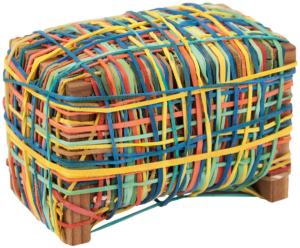
Sanja Ivekovic, whose work is based on conceptualism and feminist thought, is one of the most vital representatives of contemporary Croatian art. In her work entitled Ex/tension for the WBB project, the artist combines a post-conceptual approach with feminist criticism. On her assigned box, which she treats as ready-made, the artist draws out the essential nature of the elastic band, which has a very practical use in this work. The elastic band holds together the guidelines for participation in the WBB project, which are printed on a piece of paper and serve as a formula for the artist. The word extension, which refers to the size of the work, is interpreted by the artist as having a double meaning: that of past tension and of extension. She covers the box with multi-colored elastic bands– the kind homemakers regularly use to prepare preserves, leaving only the label of the product visible. The box thus becomes an object of soft, rounded edges, with an unrecognizable function, just as the role of the elastic bands is altered. (Statement from artist: “Please, put one rubber band over the box-let’s keep our spirit growing!!!”)
Vlasta Delimar, Why?, Croatia
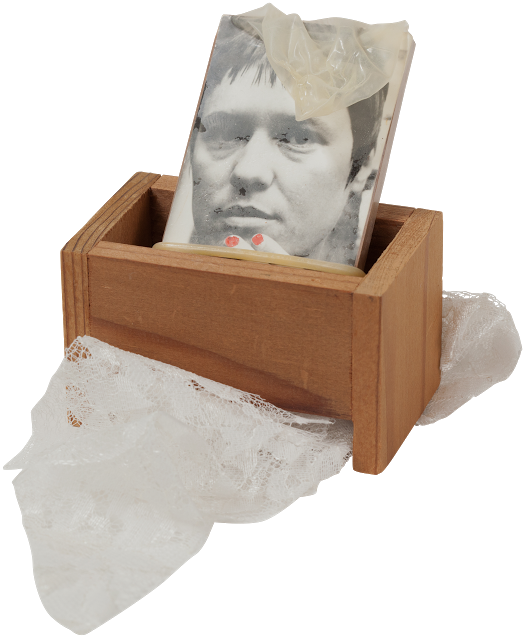
Vlasta Delimar is one of the most radical Croatian women artists. Her trademark, regardless of the medium, is her own face, which is most often a photographic self-portrait, sometimes interpolated in fixed surroundings of ambiguous meaning. We find a similar ambiguous message in her work entitled WHY? The artist perceives the box as a mother’s body, which she places on lace. a characteristic material that is frequently used in her work. With this lace she emphasizes lightness and fragility, just as the open box allows the body freedom and flotation. The artist’s photographic self-portrait is covered by a condom, quite possibly the most widespread and most advertised device in today’s world. It is no wonder then that this equally powerful and undesirable aid, blocked on the path between love and responsibility, the body’s desire and fear, is at the same time protecting the face while making it more open and vulnerable.
Jelena Peric – Untitled, 1998, Croatia
Jelena Peric is an artist who consistently continues the tradition of minimalism and post-painterly abstraction in her work. Her series regularly transforms two-dimensional models into structurally complex spatial entities. She aspires to relativize the artistic act and its uniqueness and particularity by using geometric forms, the square and rectangle, monochromatic and dichromatic color schemes, and an impersonal way of painting. In her work Untitled, she transforms the box into a post-minimalist sculpture with a simple gesture. By moving the box’s lid to its bottom, filling the newly formed hollow with pieces of red paper (the characteristic color in her work) and then setting the box upright, the artist’s “sculpture” simultaneously plays with the effect of confinement and openness as with the concept of handmade and ready-made.
Ksenija Turcic is an artist who committed herself to spatial work at the beginning of her art career. Her first works are still comprised of object-pictures, but they deny their painterly nature, testing above all spatial relationships, perspective, gravitation, flotation. In her most recent works, the material that is most often found in her installations and settings is the mirror. Simultaneously cold and sensitive to gusts of air and heat, hard and susceptible to breakage, light and dark, reflective and absorbent, this material shows itself to be ideal for the artist’s current considerations of space and our place in it. By covering the sides of the box with mirror surfaces–resting precisely one against another and constructing an inner box that looks into itself, into its own womb, into its own darkness–the artist creates an inverted situation. Instead of “expanding,” dilating the space, she destines it to disillusion and tautology. The title Open Me, however, explicitly guides one to its different life, to the game of light and reflection, change and transience, strength and fluidity.
Ivana Kesser, Personal Newspapers, 1998, Croatia
In 1994 Ivana Keser began her project titled “Exhibition of Local Newspapers”, which was envisioned as a work-in-progress. For this project, she published only one copy of her Personal Newspapers project, dated February 25, 1998. Investigating the relation between the private and public domains, the artist wittily toys with the stereotype of uniqueness, which in itself ties in with some difficulty in reference to newspapers. “Personal discourse,” small dimensions, and the publication of only one copy is her way of paradoxically increasing the value of these newspapers, transforming this otherwise inflationary product that quickly dates itself into a work of art of universal meaning.
Magdalena Pederin is among the rare Croatian women artists of the younger generation who has methodically pursued new media and interactive projects. The miniature wooden box from the WBB project serves as an old-fashioned container in which she places LED diodes–indicators of the loudness of recorded sound. Contrasting two different types of material and two different technologies, the artist suggests the need for a new sensitivity.
The simple electronic mechanism is still while the box is closed. When the lid is opened, the battery turns on and the red and green bulbs begin to light up in unison with the increase in sound, entering from the outside including that produced by talking, clapping hands, and similar movements. By tying in the various sensors and materials in this interactive entity, the artist strives to revive the idea of modern synthesis prevalent everywhere, although we are frequently unaware of it.
Peggy Orchowski, Jasna Janicijevic and Lorraine Serena
Gallery Zvono
Belgrade, Yugoslavia
November 11 – 19, 1997
Jasna Janicijevic Ph.D., Professor of the University of Belgrade, WBB Coordinator
Peggy Orchowski, Contact
SECRETS & INTIMACIES
Jasna Janicijevic Ph.D. – YUGOSLAVIA
In 1997 WBB gathered several of the most prominent Yugoslav sculptors and painters, as well as a few emerging artists. The opening exhibition of their work in Belgrade showed an unusual variety of expressions and, in a way, reflected the core of the very individual, poetic approach of each participant.
Symbolically, the idea of the box-object was voiced by WBB artist, Gordana Kaljalovic Odanovic, who wrote, “When we say a box we think of an inner room, a secret, intimacy, a safe place, opening, closing, but first of all, of female forms.” These are some conceivable associations. As a gathering point of life energies and the last breath, it can be a cradle as well as a sarcophagus. The life cycle (from birth to death) is closely connected with this multi-evocative object.
Gordna Kaljslovic Odanovic- Model of Intimacy
A box exists by its void which keeps it safe. The inside of the box corresponds to the outside as a positive form to the negative one. Whether small or large, deep or low, long or narrow, it evokes the feeling of intimacy, safety, but also of bodily sensations: touching, holding, feeling. A mechanism of the will to possess, opens its numerous drawers.
Some of the Yugoslav artists present themselves through their own thoughts:
An essay by Milica Stevanovic appears in her new book, titled Perspective in Gravitational Fields and Other Themes. Paintings, drawings, and objects deal with the exploration of perspective in a space where things are permanently contorted, if we understand the contortion as mutual influence among the things themselves as well as between us and them. The lines of these influences or actions form a certain “contorted space,” which we can treat as a contorted space of our own consciousness from which emerge the images of the objects we observe or imagine.
One of the imagined objects appears in her box Unknown Thing. The lid of the box has opened and something “I do not know what” gushed out of it. Something I do not want or maybe do not have to know (to name), since it was not supposed to be named. Perhaps that was what moved the lid. Looking from outside, a box is almost always a shelter– of a secret, of some unpredictable power, of different unexpected things. (Even something that we ourselves put away in some box, could become, after a time, a surprise).
One can never tell if something, or what, will come out of the box, opened or even demolished. Looking from the outside, there is something Unpredictable and Infinite in the box. Looking from inside, a box means something quite opposite: closeness between the walls of the predictable, the entropy of certainty. However, the very event of opening/destroying the box does not allow taking an easy watching distance. Or, does not give a chance for choosing and changing the point of view (on the relation outside-inside). “The opening of the box” as an action or event confronts us directly with a unique, raw, naked reality, with the need to define ourselves critically toward it and to involve ourselves in the events with our own activity. The titles for this event (“opening of the box”) therefore, could be different, although they all say (almost) the same thing: power of change, life, protest, play, etc. and of all that seems to be inevitable, though we do not know what it will be like.
Nevena Hadji-Jovancic sculptures are fragments of reminiscence, but they are also literal physical fragments. It is important that each sculpture, each piece has enough space and therefore reminds us of still life. They are loud forms because of the versatile material: acrylic on velvet and painted plaster. Also, her sculptures are noisy, since the color with its smoothness, its uniformity, connects scattered parts into one plane. But the color is unusual, as in her tiger colored box, with little figures of animals, the memories of childhood: Yes, I Remember.
Borislava Nedeljkovic-Prodanovic is a sculptor, painter, and craftsman, working with clay and metal, which helps her to seek through the transparency of the world for the new non-descriptive forms, always strong and vigorous but at the same time light and small. Just like her box Atlas, which establishes not only a dialogue between the material and space but also between different materials: aluminum and wood. Her sculptures stick to the space, adapt to it without confrontation, but they also fight for survival and oppose the limits of spatial and spiritual existence.
Gordana Kaljalovic-Odanovic tries to expand traditional artistic expression as well as the associative dimension of the work of art. The chosen medium– wood– the ways of treating the planes, the leveling of the rhythms, cuts and carvings, suggest some subtle variations of the objects. Attached to the pure plastic form, the ways of building by constructing and composing, reduction and cleanliness, typical of modernist practice, are visible in her sensitively planned and carefully built sculptures. The visual impact and the power of attraction of these integral forms full of intimate geometry, suggest an open and subtle emotional experience.
Darja Kacic‘s main concept, which defines the context of her work, deals with permanent movements, assimilation, and colonization of new territories. Her Vivarium for Snowflakes and Stardust, refers to the little box as an object for a woman, containing all the exquisiteness, wealth and mystery, safety and dreams she possesses, as well as her disorders. It is her tiny pet-toy, which she never abandons throughout her whole life. Fluently changing so many of her daily roles, she tugs her little vivarium along, and in it her snowflakes and glitters, snakes and puppies, babies and tears.
Rosa Martinez, Independent Art Critic and Curator – SPAIN – 1995
The prestigious Belgian anthropologist Levi-Strauss said that, looked at over the millennium, passions have not changed substantially and to omit at random ten centuries wouldn’t effect significantly our knowledge of human nature; the only irreparable loss would be the works of art that had been produced. Artistic creations reflect thought structures, conserve memory, and translate the existential and aesthetic preoccupations of their time allowing the projection of ghosts, the solidification of beliefs and the outlining of utopias.
Women Beyond Borders is an exhibition that began its world tour the 5th of December 1995, at the Contemporary Arts Forum of Santa Barbara (California). It conveys, in a very specific way, the global desire for dialogue and the need for connection that inspires many women on this planet who are preoccupied with establishing new lines of collaboration and interchange which widen established channels, in order that our voices can be heard. Taking off from this base, a group of artists from Santa Barbara began to enlarge the project and have succeeded in weaving a wide international network that is spreading through many continents and which has welcomed, up to now, women artists and curators from the United States, Kenya, Mexico, Cuba, France, Spain, Austria, Israel, Argentina, Japan, Sweden, and Finland, to mention a few of the first countries included in the convocation.
The inspiration has been a small wooden box, copies of which have been sent from California to the curators of each country who in turn have been responsible for selecting 12 artists and asking them to freely transform this common object. The format, the design, the material of the box and the requirements for installation condition enormously the creative possibilities. However, these have not been obstacles for the creativity of the artists who have taken off in many directions with statements that go from the ethnic to the philosophical passing through nostalgic origins, religion, memories of journeys and questions of sexual roles and generic identities.
One of the most surprising conceptions is that of Victoria Gal, who presents a funeral ritual by putting a dead hedgehog in her box. She buried it for 4 months in the countryside of Extremadura and then dug it up; provoking reflection on the effect of the passage of time on the living and the dead. One of the most ironic was that of the American, Ana Jonsson, who has a woman dressed in red hanging over a simulation of a tampon box alluding to a reality that women cannot escape, that of the role of wife and mother.
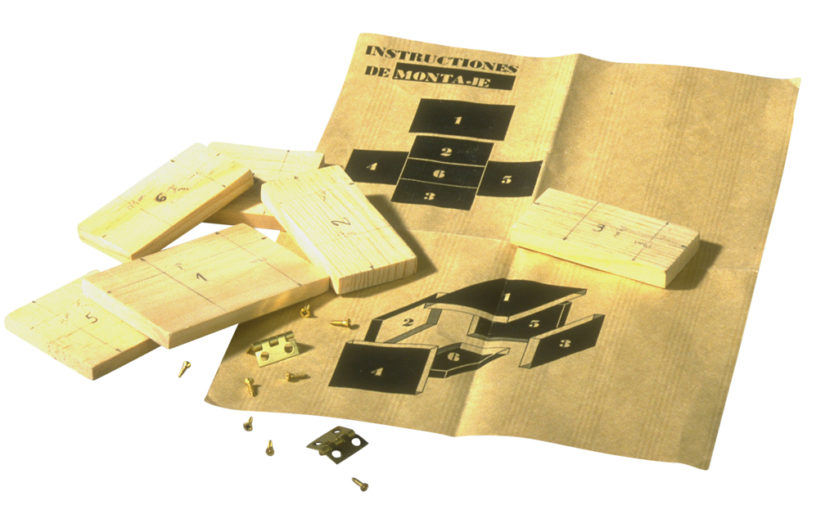
While the majority were willing to work within the limitations that the box imposed, respecting the measurements and just adding color, small objects, photographs or other materials, some artists went further, questioning the physical aspect of the object itself. The Catalonian artist, Eulalia Valldosera, for example threw away the original box and put in its place another of transparent plastic into which she placed phalanges of the ring finger of a dead woman on which she put a ring, alluding dramatically to the symbolic death of love. The Valencian woman, Ana Navarrete, took the box apart and after carefully recording the measurements of every part of the box put the six pieces into a plastic bag along with instructions on how to put it back together. The ideas of play, destruction and reconstruction are implicit in this operation while underscoring the question of closed structures and a will to rethink reality, even though the possibilities of creating new situations appear limited. This same type of questioning appears in the work of Ciel Bergman from New Mexico, who interprets the box as a metaphor of human logic, valuable for organizing and systematizing, but capable also of repressing and shutting up the pulses or impulses of the body. Ciel Bergman filled her box with translucent wax, having previously put a needle, blood, and thread inside. According to her, the needle under the skin symbolizes the effort of women to cure, to sew up the wounds of a world based on war and conflict. Wax also appears in the project of the woman from Andalucia, Carmen F. Sigler, who reflects upon how formalities that institutionalize our identity limit us and close off possibilities. The idea of existential and aesthetic traps that hover over women as mother and as artist are present in the piece of the Israeli, Deganit Schocken, whereas the Argentinean, Gloria Priotti, in her work “The challenge” alludes to the effort that we still have to make and the walls that still need to come down.
One of the most unsettling pieces is by the Basque artist, Begona Montalban, who has placed, on the inside top of the box, a photograph of the eyes of a woman whose eyelids are drooping drastically because of a nervous disorder. In an attempt to overcome this situation she has fixed a hairpin on one eyelid to hold it open. Turning the box around, we see that Begona has converted it into a hairpin container, expressing the will to fight. The Mexican artist Lilian Ribeiro, from Oaxaca, transformed her box into a baroque jewelry box, a container in which silver relief images and decoration allude to a past that is remembered with nostalgia. The Argentinian, Mirta Tocci, who has been working with the poetry of the heart, converted her box into a metaphor of this organ encircling it completely with a cord to allude to the frequent impossibility of extending itself to another.
The Spanish artist, Akane Asoka, presents a very delicate work on the myth that is told to the little girls of her country that says that each one is tied to her future husband by her little finger with an invisible red thread. Akane has created a suit where a masculine shirt (coming out of the box) is joined to a feminine dress (lying on the floor) uniting the two with a red thread.
The quality of small miniatures that all these works share speaks of the need for facilitating the transport of an exhibition that has been made without counting on institutional financing and that has only been possible thanks to the interested collaboration of artists and curators. It reflects also the confinement to which women have been submitted artistically. It speaks of boxes in which secrets are guarded. It suggests the generosity of the offerings. It alludes to closed worlds, to small objects in which meanings are condensed, and to a domestic tradition in which decoration and handicrafts have been the pillars on which feminine creativity has been sustained. Departing from this reality generates conflicting emotions. On the one hand, women enjoy the diversity of approximations and styles, on the other hand, we demand other spaces and other formats which permit us to grow artistically.
The show will continue to receive new contributions. It will then begin in New York and go on, among other places, to the Contemporary Gallery of Jerusalem, the Kunstterhaus of Grasz, the Contemporary Gallery of the National Museum of Kenya in Nairobi, the Kulturhuset of Stockholm and the Centro Wifredo Lam in Havana. In Spain conversations have begun with Maria Luisa Lopez, director of the Museum of Contemporary Art in Seville.
The transcultural character of the show, like the connections through “Femail” and the Internet, contributions to establishing modalities of dialog that permit us to continue to profile the feminine perspective which, as the art critic Suzi Gablik says, has been absent not only from politics and scientific thinking but also from aesthetic philosophy. Questioning the power of big exhibitions and the hierarchy that separates great art from small works, this exhibition of Women Beyond Borders will contribute to the articulation of the theory and the practice of a new social construct of reality and play an important role in creating other anthropological visions.
Get Updates
Enter your email address below to signup for our newsletter. We promise to never sell your info.

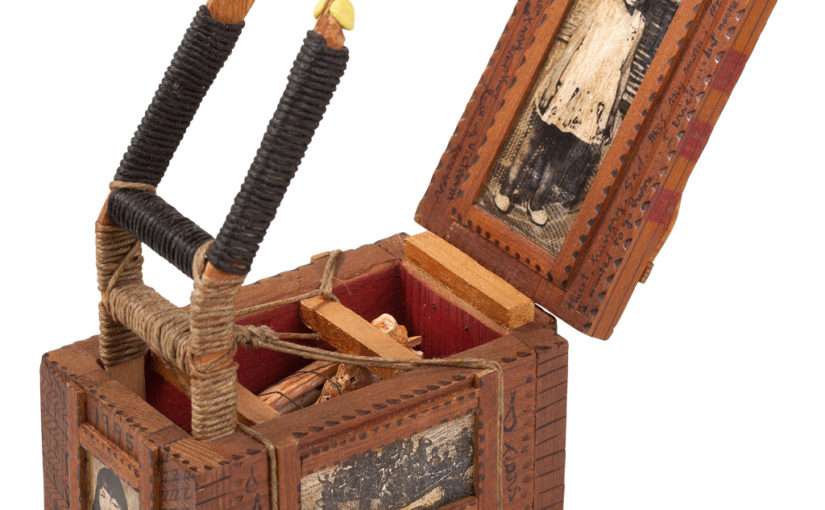
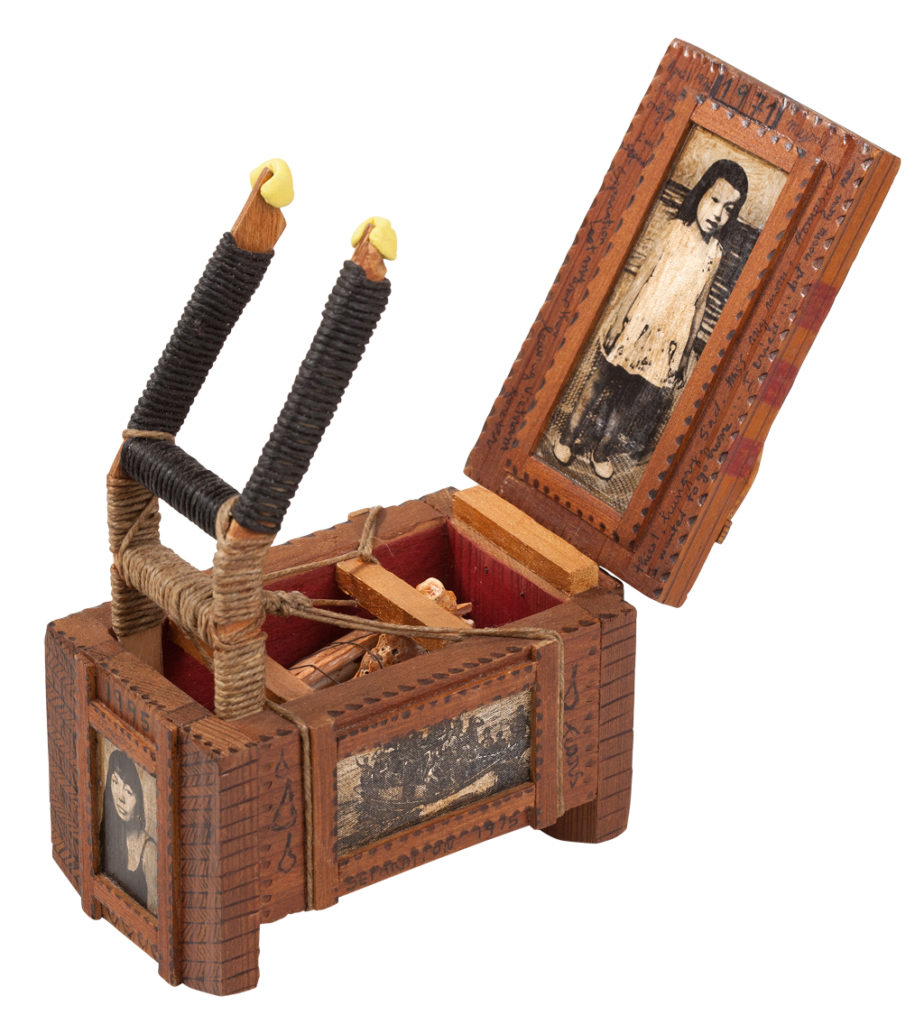
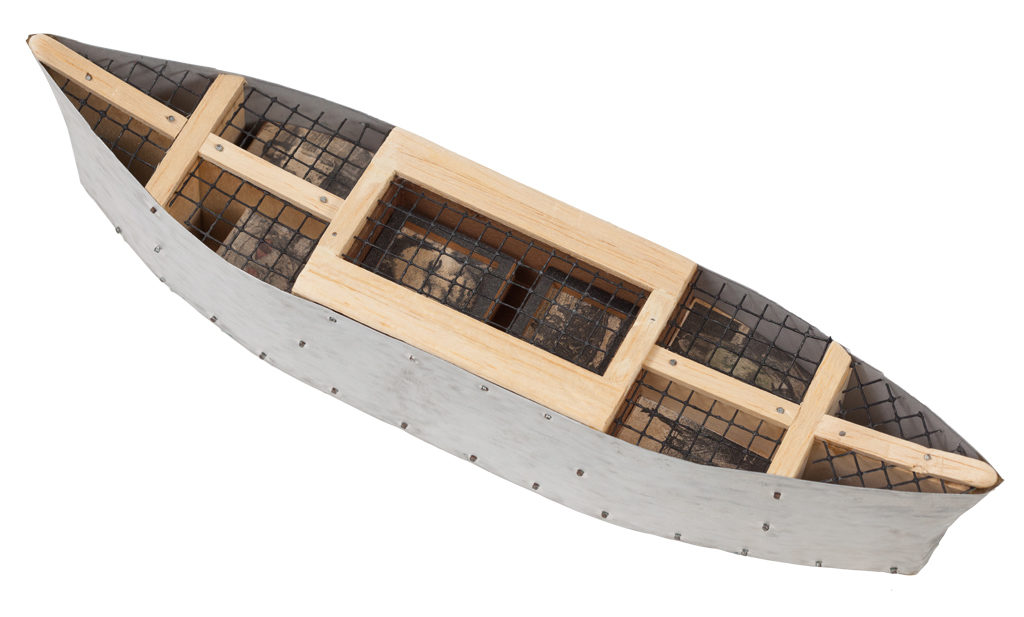
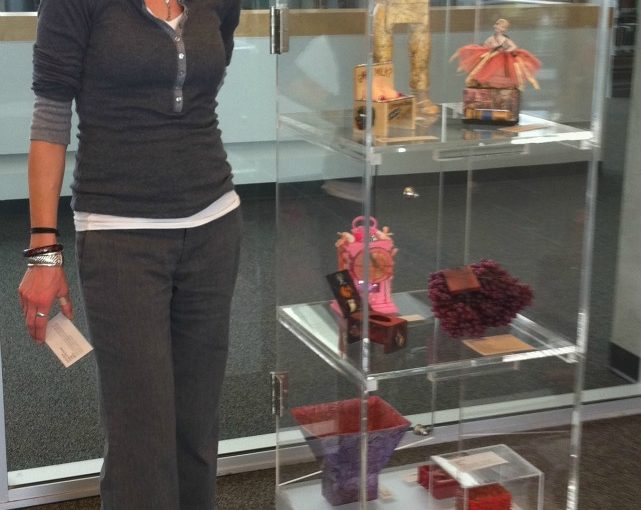


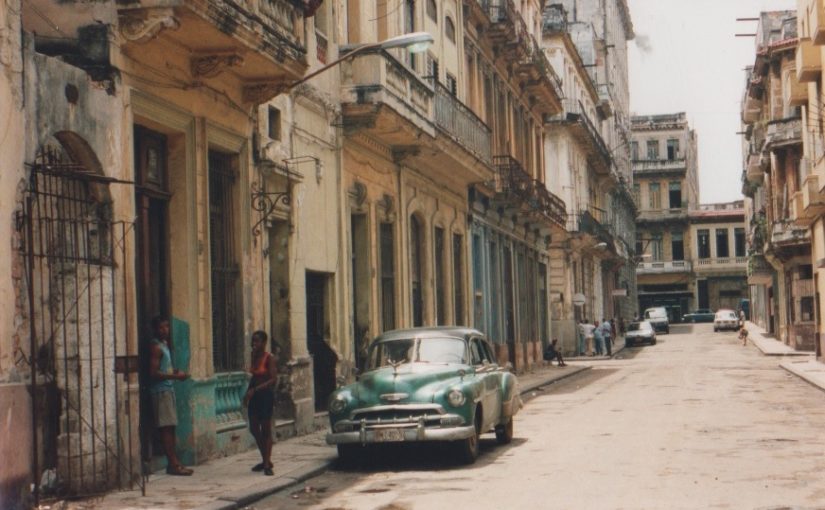
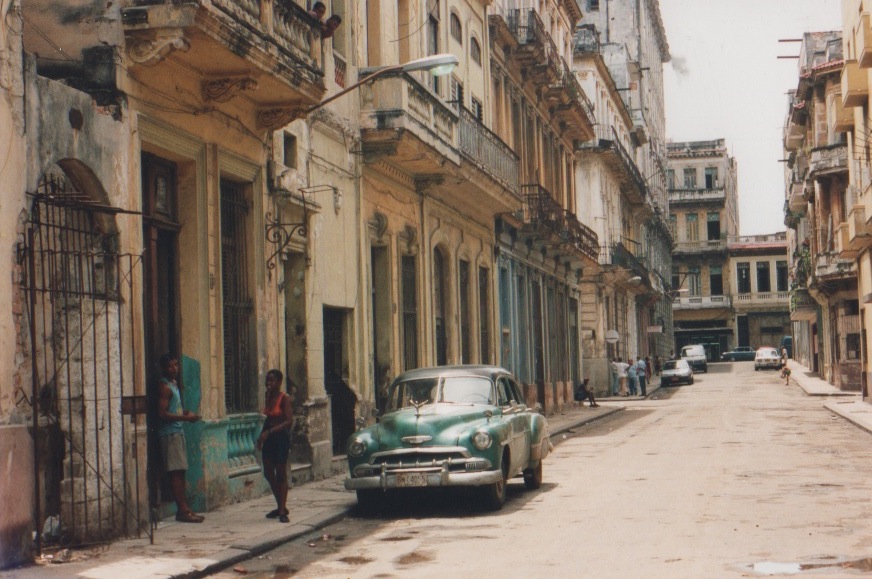
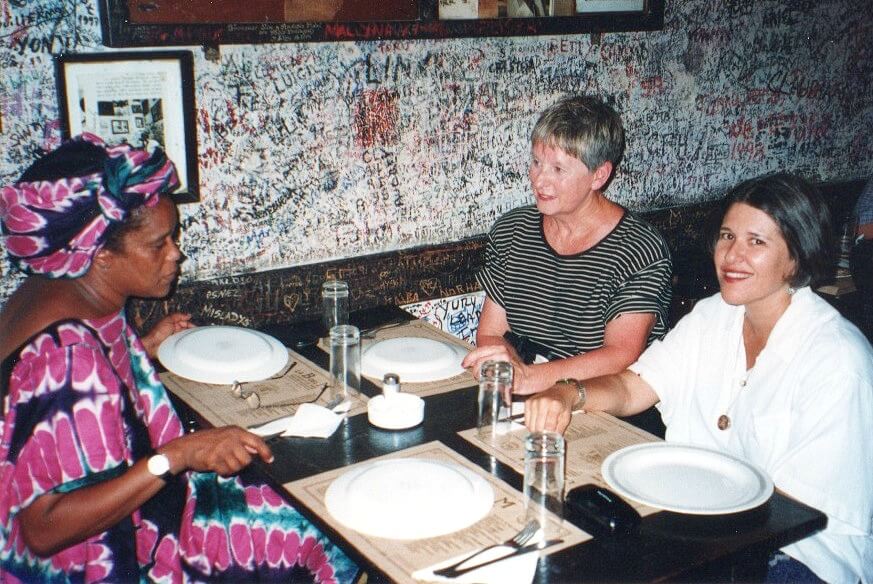
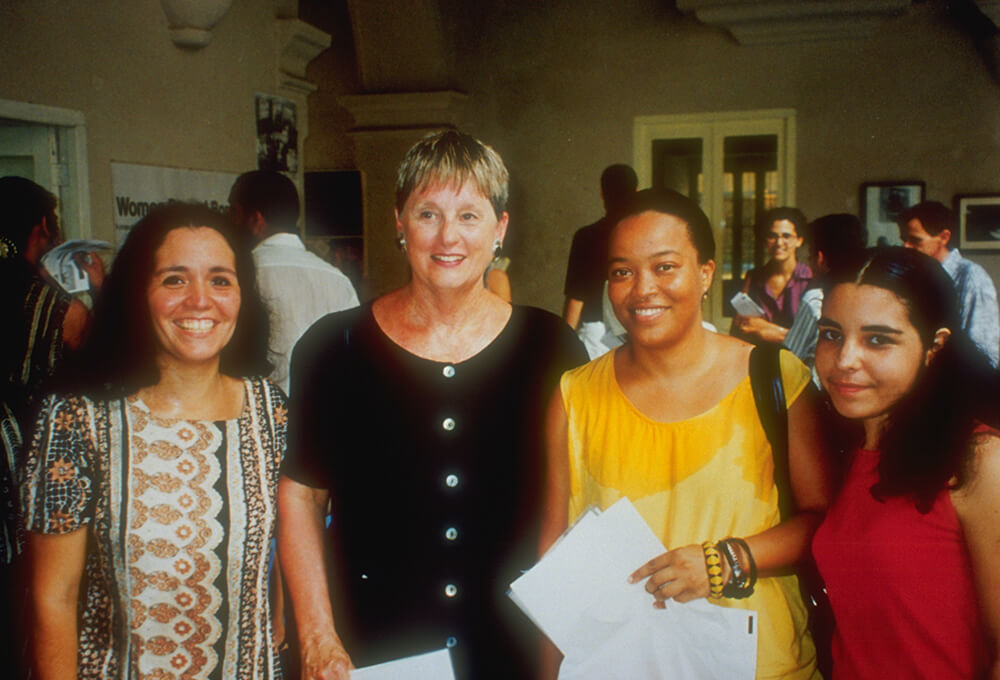
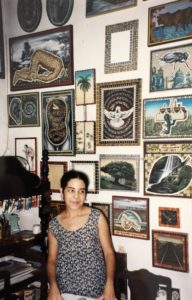
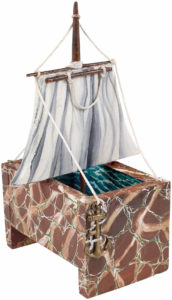
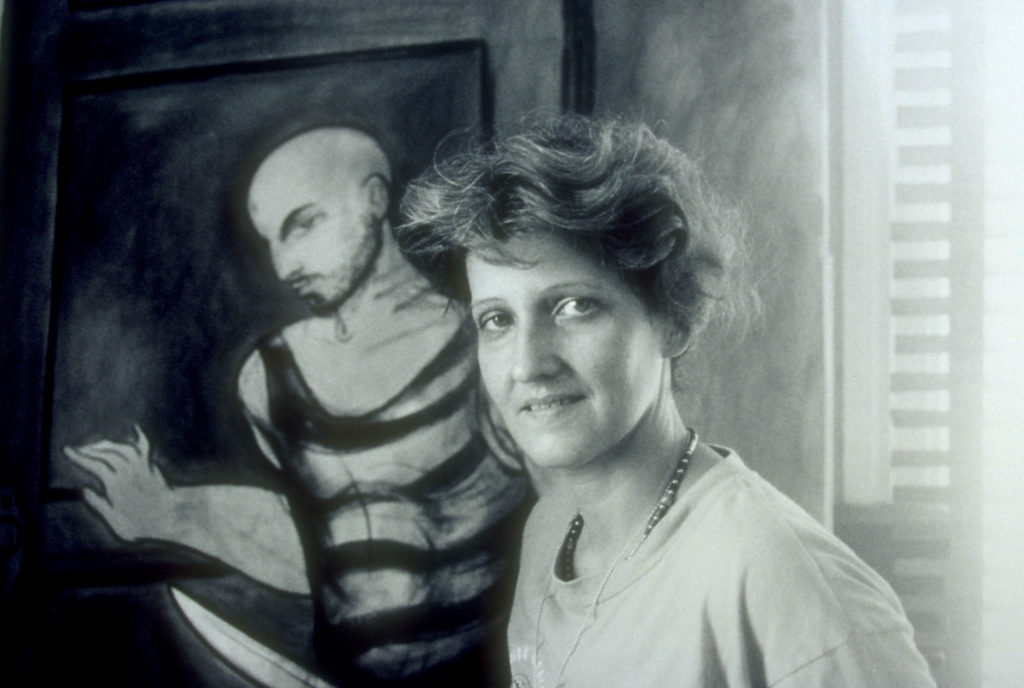
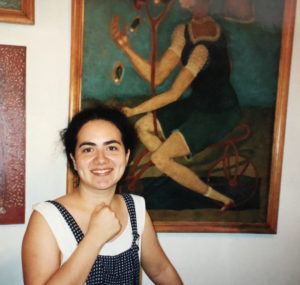
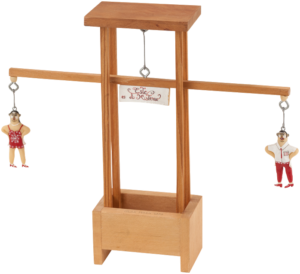
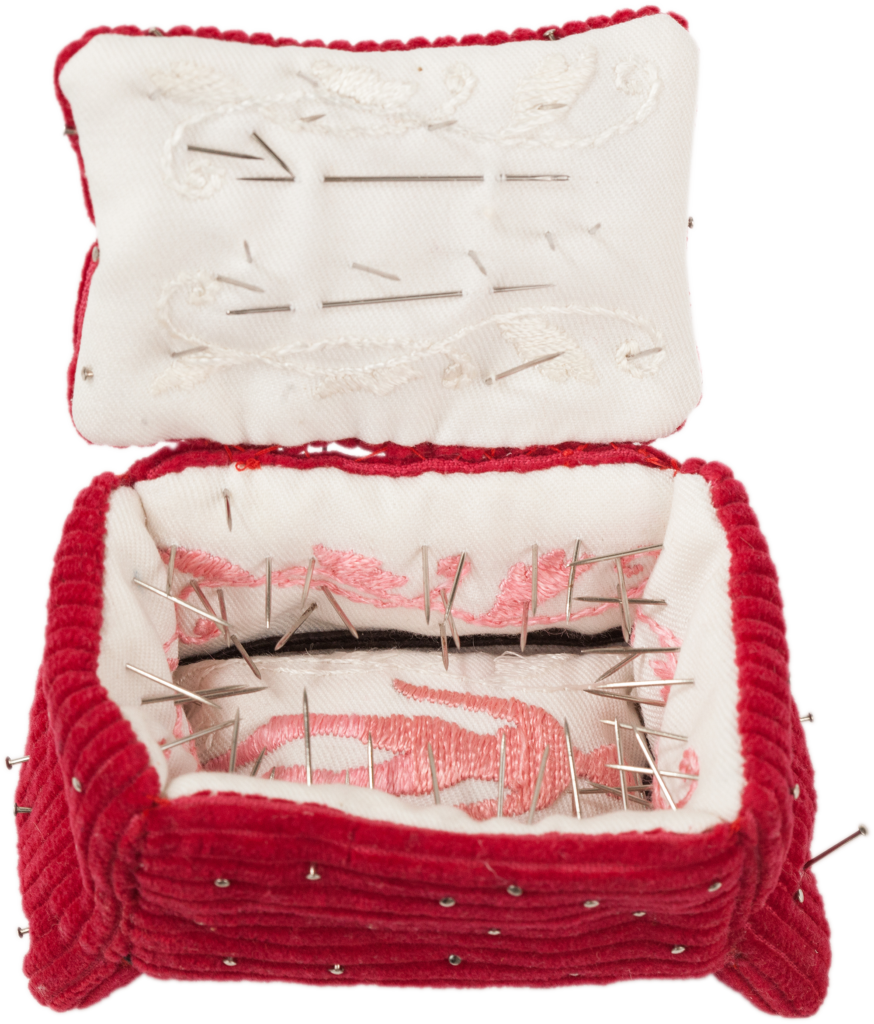
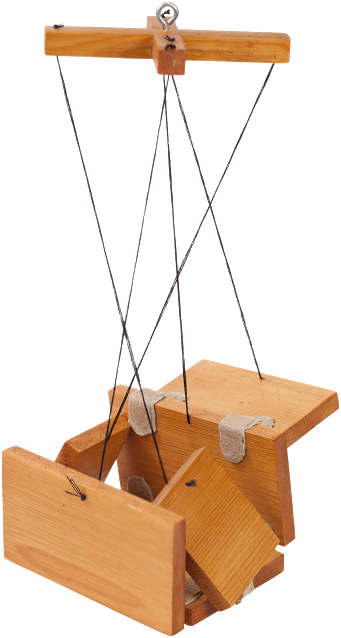
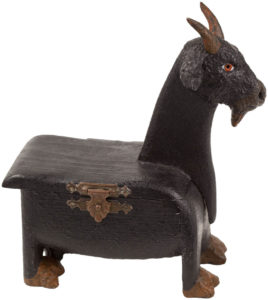
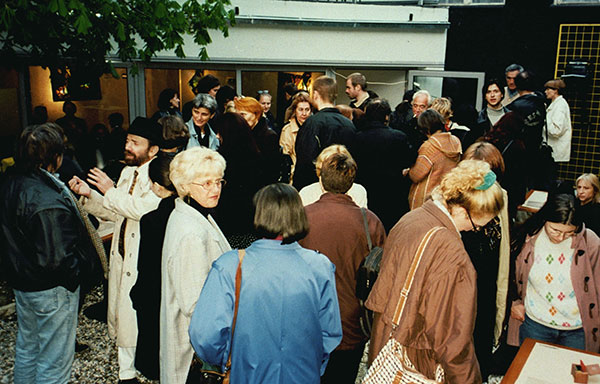
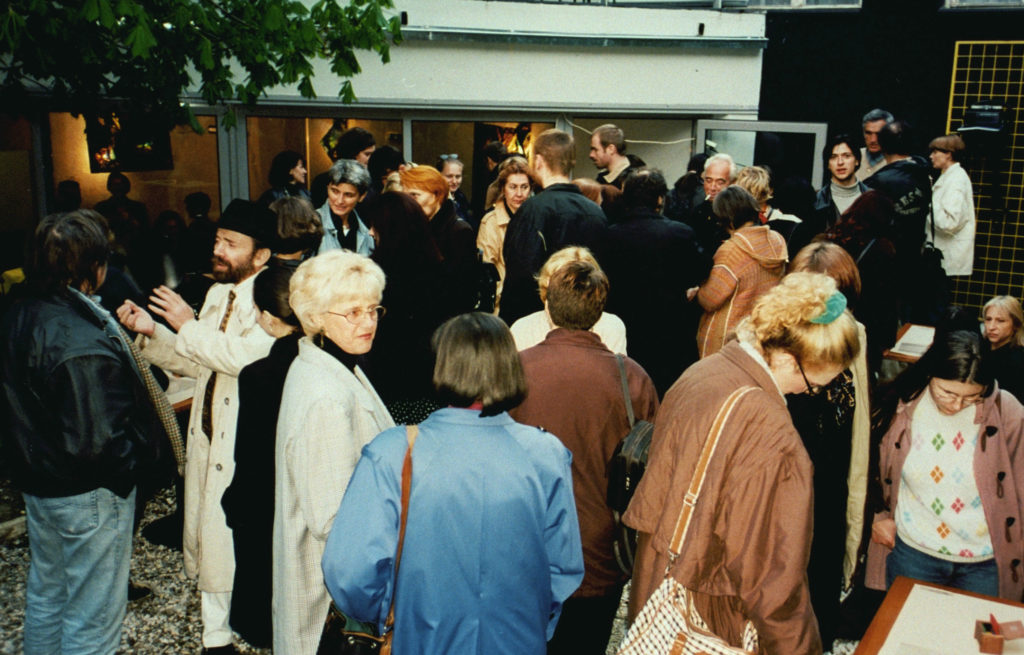
 An indoor and outdoor installation of boxes from Croatia, Bosnia-Herzegovina, and Slovenia was arranged by Nada Beros, curator of the Zagreb Museum of Contemporary Art. In addition, a virtual exhibition of boxes from around the world was projected on the walls. Women participants from Sarajevo were in Zagreb for three days for the event.